

Medication-Induced Angioedema Risk Checker
Assess Your Medication Risk
Medication-induced angioedema can be life-threatening. This tool identifies if you're taking medications with known angioedema risk and provides immediate next steps.
Select Your Current Medications
Risk Assessment Results
Your Risk Level:
Critical Warning Signs
If you experience any of these symptoms while on high-risk medications, seek emergency care immediately:
- Sudden swelling of lips, tongue, or throat
- Difficulty swallowing or feeling like something's stuck in throat
- Hoarseness or muffled speech
- Wheezing or stridor (high-pitched breathing)
- Abdominal pain or nausea
Recommended Next Steps
Swelling in your lips, tongue, or throat might seem like a bad allergic reaction-but if you’re taking certain medications, it could be something far more dangerous and harder to treat. This isn’t just a rash or hives. This is angioedema-deep, sudden swelling that can block your airway in minutes. And if it’s caused by a common prescription drug, standard allergy treatments won’t work. You could be in serious danger without even realizing it.
What Exactly Is Medication-Induced Angioedema?
Angioedema is swelling that happens deep under the skin or mucous membranes-not on the surface like hives. It can hit your face, lips, tongue, throat, hands, feet, or even your intestines. When it’s triggered by a medication, it’s called drug-induced angioedema. Unlike typical allergic reactions, it doesn’t always come with itching or redness. Sometimes, the only sign is sudden, asymmetrical swelling that grows over hours.
It’s not rare. About 30% to 40% of all medication-related angioedema cases come from ACE inhibitors-drugs like lisinopril, enalapril, and ramipril, commonly prescribed for high blood pressure and heart failure. Around 0.1% to 0.7% of people taking these drugs develop angioedema. But for African Americans, the risk jumps to as high as 2.2%. Women are also more likely to be affected than men.
Here’s the scary part: this swelling can happen anytime-even after years of taking the medication without issue. A patient might take lisinopril for five years, feel fine, then wake up one morning with a swollen tongue. That’s not unusual. And if it reaches the throat, breathing can become impossible within 15 to 30 minutes.
Two Very Different Types of Angioedema
Not all drug-induced angioedema is the same. There are two main types, and they need completely different treatments.
Mast cell-mediated (histaminergic) angioedema is what most people think of as an allergic reaction. It’s triggered by drugs like penicillin, aspirin, or NSAIDs (ibuprofen, naproxen). This type causes itching, hives, and swelling. It responds to antihistamines, corticosteroids, and epinephrine. If you’ve ever used an EpiPen for a bee sting, this is the kind it works on.
Bradykinin-mediated angioedema is the silent killer. It’s caused by ACE inhibitors and, less commonly, ARBs (like losartan or valsartan). It doesn’t involve histamine. That means antihistamines and epinephrine? Useless. Corticosteroids? Won’t help. The swelling comes from a buildup of bradykinin, a protein that makes blood vessels leak fluid into surrounding tissue. The result: deep, painless swelling that can swallow your airway without warning.
Doctors often mistake bradykinin-mediated angioedema for an allergic reaction. They give Benadryl and prednisone-and the patient keeps swelling. The American Academy of Allergy, Asthma & Immunology says this misdiagnosis is common. And every hour it goes untreated, the risk of intubation or death rises.
Which Medications Are Most Likely to Cause It?
Some drugs carry a much higher risk than others.
- ACE inhibitors (lisinopril, enalapril, captopril): The #1 cause. Responsible for 30-40% of all drug-induced cases.
- ARBs (losartan, valsartan, irbesartan): Even though they’re meant to be safer alternatives, they still carry a 50% risk of triggering angioedema in people who’ve had it from ACE inhibitors.
- NSAIDs (ibuprofen, naproxen, celecoxib): Can cause mast cell-mediated swelling, especially in people with asthma or nasal polyps.
- Penicillin and other antibiotics: Classic triggers for allergic-type angioedema.
- Aspirin: Can trigger both types, especially in people with chronic hives or sinus issues.
It’s not just about the drug class-it’s about your body’s response. If you’ve ever had unexplained swelling after starting a new medication, even years ago, that’s a red flag. Don’t assume it was a one-time thing. The risk of recurrence is real.
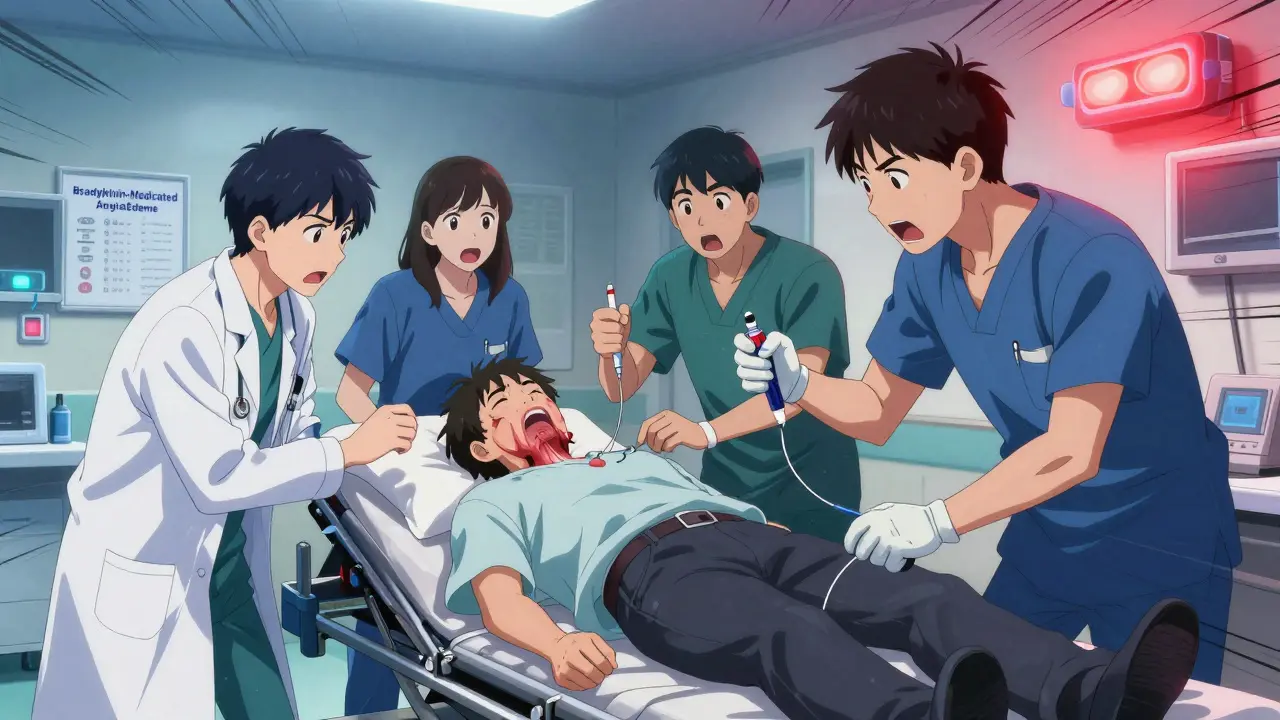
Warning Signs You’re in Danger
Not all swelling is an emergency. But these symptoms mean you need help right now:
- Sudden swelling of the lips, tongue, or throat
- Difficulty swallowing or feeling like something’s stuck in your throat
- Changes in your voice-hoarseness or muffled speech
- Noisy breathing, wheezing, or stridor (a high-pitched sound when you breathe in)
- Sudden abdominal pain, nausea, or vomiting (swelling in the gut lining)
- Fainting or dizziness
If you have any of these-and you’re on an ACE inhibitor, ARB, or NSAID-call 911. Don’t wait. Don’t take another antihistamine. Don’t hope it’ll go away. Airway swelling doesn’t care if you’re ‘just a little swollen.’
What Happens in the Emergency Room?
If you arrive with suspected angioedema, doctors need to know two things fast: Is this histamine-driven or bradykinin-driven?
For mast cell-mediated cases:
- Epinephrine (0.3-0.5 mg injected into the thigh) is first-line. It works in minutes.
- IV antihistamines like diphenhydramine reduce swelling and itching.
- IV corticosteroids (like methylprednisolone) prevent rebound swelling.
For bradykinin-mediated cases (like ACE inhibitor-induced):
- Epinephrine? No effect.
- Antihistamines? No effect.
- Corticosteroids? Usually no effect.
Instead, treatment relies on specific drugs that block bradykinin:
- C1 esterase inhibitor concentrate (Berinert, Cinryze): Replaces a missing protein that normally controls bradykinin.
- Icatibant (Firazyr): A shot that blocks the bradykinin receptor. Works in 30 minutes.
- Ecallantide (Kalbitor): Stops kallikrein, the enzyme that makes bradykinin.
These drugs aren’t in every ER. That’s why misdiagnosis is so common. If you’ve had this before, carry a medical alert card or app listing your condition and the exact drugs you need.
What You Should Do After an Episode
Surviving one episode doesn’t mean you’re safe. About 15% to 30% of people have another attack-often worse-if they keep taking the trigger drug.
Here’s what to do:
- Stop the medication immediately. Never restart an ACE inhibitor, ARB, or NSAID after an angioedema episode unless directed by an allergy specialist.
- See an allergist or immunologist. They can test for the type of angioedema and confirm the trigger.
- Get a medical alert bracelet. It should say: ‘Angioedema-ACE Inhibitor Trigger-Epinephrine Ineffective.’
- Ask for a prescription for icatibant or C1 inhibitor. If you’re at risk for recurrence, you may need to carry one at all times.
- Inform every doctor you see. Even your dentist. Many don’t know the risk.
One patient on Reddit shared: ‘My doctor kept telling me it was allergies for three years while I was on lisinopril. Lost two teeth from tongue swelling before they finally connected the dots.’ That’s not rare. That’s systemic failure.

Why This Keeps Happening
Over 50 million Americans take ACE inhibitors. They’re cheap, effective, and widely prescribed. But the risk of angioedema is real-and often ignored.
A 2022 survey found only 45% of primary care doctors correctly identified ACE inhibitors as the #1 cause of drug-induced angioedema. Many still treat it like a simple allergy. Emergency rooms aren’t always stocked with bradykinin blockers. And patients? They’re often sent home with a prescription for Benadryl and told to ‘avoid allergens.’
The FDA has had black box warnings on ACE inhibitors since 1999. But warnings don’t change practice. Only awareness does.
What’s Changing for the Better
There’s hope. In 2023, the World Allergy Organization updated guidelines to standardize diagnosis between histaminergic and bradykinin-mediated types. In pilot studies, diagnostic accuracy jumped from 65% to 89%.
New drugs like sebetralstat (approved in 2023) are oral kallikrein inhibitors showing promise for bradykinin-mediated cases-even those triggered by medications. The European Academy predicts a 30% drop in deaths from medication-induced angioedema by 2028-if doctors learn to recognize it.
But until then, the burden falls on you.
Final Advice: Know Your Meds, Know Your Risk
If you’re on an ACE inhibitor or ARB and you’ve ever had unexplained swelling-even once-stop taking it. Talk to your doctor. Ask: ‘Could this be angioedema?’ Don’t wait for a second episode. Don’t assume it was a fluke.
If you’ve had an episode before, carry a medical alert card. Learn the difference between antihistamines and bradykinin blockers. Tell your family what to do if you can’t speak.
Angioedema from medications isn’t a rare curiosity. It’s a silent, treatable, and preventable emergency. The only thing standing between you and disaster is knowing the truth-and acting on it before it’s too late.







Comments
Man, I never realized how many people are just getting sent home with Benadryl after swelling up. My cousin had this happen on lisinopril and they told her it was a "bad allergy." She ended up in the ER with her tongue blocking her airway. If this post saves one life, it’s worth it.
Doctors need to stop treating this like a seasonal allergy. It’s not. It’s a silent timer counting down to intubation.
I just read this and felt my throat tighten. Not because I’m swollen, but because I know someone who almost died from this and no one knew why. It’s terrifying how common these meds are and how little we’re told. Thanks for laying it out so clearly. We need more posts like this.
Oh please. Another ‘awareness’ post. You think people don’t know ACE inhibitors are risky? They’re listed in the damn pamphlet. If you can’t read a medication guide, maybe don’t take pills.
Also, 2.2% risk for African Americans? That’s not a surprise-genetics isn’t a mystery. Stop pretending this is some conspiracy.
bro i took lisinopril for 3 years and never had swelling 😎
but i did get a rash once from ibuprofen so maybe im just lucky 🤷♂️
also why is everyone so scared of medicine? 🤔
i had this happen to me after taking ramipril for 4 years
woke up with my lips like balloons
went to the doc they gave me benadryl
it got worse
finally got to a specialist 3 days later
they said i was lucky i could still breathe
now i carry icatibant
if you on ace inhibitors and ever feel weird swelling
stop it
no excuses
you dont want to be me
OMG I KNEW IT!!! I TOLD MY DOCTOR FOR YEARS THAT MY TONGUE WAS SWELLING BUT SHE SAID I WAS "OVERREACTING" AND THAT I "JUST HAD ALLERGIES"
THEN I LOST TWO TEETH AND MY MOUTH WAS FULL OF BLOOD AND STILL SHE SAID "TRY ANTIBIOTICS"
WHY DO DOCTORS HATE US??
WHY IS THIS STILL HAPPENING??
I’M STILL SCARED TO SLEEP NOW 😭
As someone who’s lived in three countries and seen healthcare systems from India to Germany to the U.S., I can tell you this is a global blind spot. In rural India, they prescribe ACE inhibitors like candy. In Germany, they screen for bradykinin markers before prescribing. The disparity is criminal.
And yet, here we are, still treating a life-threatening vascular condition like a cold.
This post didn’t just inform me-it changed how I see my own health. I’ve been on lisinopril for six years. I’ve had that weird, silent puffiness around my lips a few times, but I thought it was just dehydration or stress.
Now I’m scheduling an appointment with an allergist tomorrow. I’m not waiting for a second episode. I’m not risking my airway for a myth that "it’s just allergies."
Thank you for writing this with such heart. You turned fear into action.
Benadryl doesn’t work. Epinephrine doesn’t work. You’re just lucky if your ER has icatibant.
Most docs don’t know. Most patients don’t know.
So we die quietly.
That’s it.
Okay, let’s go deeper. Why does bradykinin accumulate in the first place? ACE inhibitors block the enzyme that breaks down bradykinin-so it builds up like a traffic jam in your blood vessels. But here’s the twist: some people have genetic variants in the kallikrein-kinin system that make them hyper-sensitive to even tiny amounts of bradykinin.
That’s why two people can take the same drug, one gets a sneeze, the other gets a swollen tongue. It’s not random. It’s biology. And we’re not screening for it.
Imagine if we had a simple genetic test before prescribing these drugs. We could prevent 90% of these cases. But we don’t. We just keep prescribing and hoping.
And people wonder why medicine feels so broken.
THIS IS SO IMPORTANT. I’m a nurse and I’ve seen this happen twice. One guy thought he was having a stroke because his face was swollen. Turned out it was losartan. He was fine after icatibant. But if we’d given him Benadryl? He’d be dead.
Every single time I see someone on an ACE inhibitor or ARB, I ask: "Have you ever had unexplained swelling?"
Most say no. But then they pause. And then they whisper: "Actually… yeah, once. Years ago."
Don’t wait for the second time.
so you’re saying if i take benadryl for swelling and it doesnt work… maybe its not allergies?
mind blown.
also i just took lisinopril yesterday… im gonna go check my lips in the mirror now lol
I’m so glad someone finally put this out there in plain language. I’ve had two friends nearly die from this, and both were told it was "just an allergic reaction." One of them had to be intubated. The other had a tracheostomy. Neither knew their meds were the cause.
Please, if you’re on any of these drugs, and you’ve ever had swelling-no matter how small-get tested. Don’t wait. Don’t assume. Don’t trust the first answer.
And if you’re a doctor-stop treating this like a dermatology problem. It’s a vascular emergency.
Let’s be real: the pharmaceutical industry doesn’t want you to know this. Why? Because if people stopped taking ACE inhibitors, they’d lose billions. So they bury the data, downplay the risks, and let primary care docs handle it like a routine allergy.
And we’re the ones paying with our tongues.
Also, I once had a doctor tell me, "You’re too young to have this."
Guess what? I was 28. And I almost died.
Thank you for sharing this. I’m from India and we see so many patients on lisinopril without any warning. I’ve had patients come in with swollen tongues and no idea why. We don’t even have icatibant in most hospitals here.
But now I’m going to start asking every patient on ACE inhibitors: "Have you ever had swelling?"
One question could save a life.
And if you’re reading this and you’re on one of these meds-please, don’t ignore that little puffiness. It’s not just stress. It’s your body screaming.