
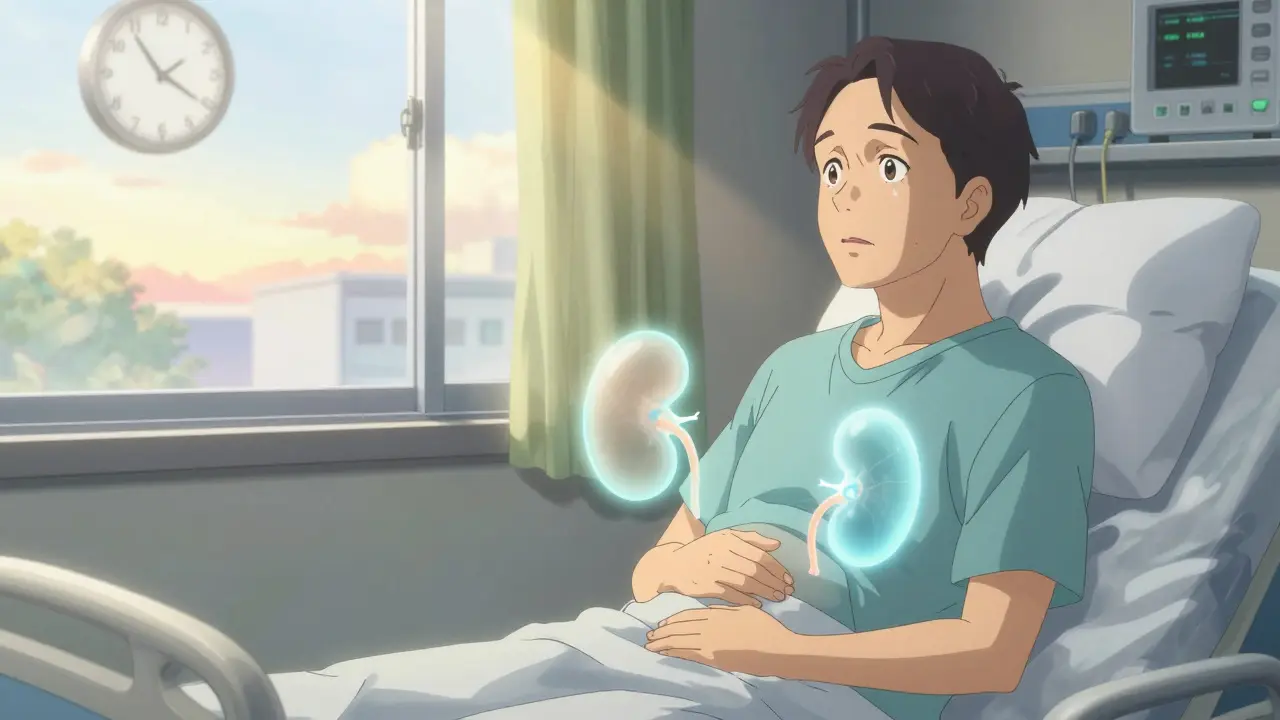
When your kidneys fail, life changes. Dialysis keeps you alive, but it doesn’t give you back your life. For many people with end-stage renal disease (ESRD), a kidney transplant is the best path forward-not just for survival, but for living better. It’s not a simple fix, though. There are strict rules to qualify, a major surgery to get through, and a lifetime of care afterward. If you’re thinking about a transplant, here’s what you really need to know.
Who Can Get a Kidney Transplant?
Not everyone with kidney failure is a candidate. The goal isn’t just to replace the organ-it’s to make sure the transplant actually works and that you can stick with the treatment. Most transplant centers require you to have end-stage renal disease, meaning your kidneys are working at 15% or less of normal capacity. That’s measured by your glomerular filtration rate (GFR), which should be 15 mL/min/1.73m² or lower. Some centers, like Mayo Clinic, may consider you if your GFR is up to 20 mL/min, especially if it’s dropping fast or you have a living donor ready.Age alone doesn’t disqualify you. While Vanderbilt University Medical Center sees age 75 and older as a potential risk, UCLA doesn’t set a hard cutoff. Instead, they look at your overall health: heart function, lung capacity, strength, and mental clarity. Frailty matters more than years. Tests like grip strength, walking speed, and how easily you get tired help doctors decide if your body can handle the surgery and recovery.
Obesity is another major barrier. A BMI over 35 raises your risk of complications-wound infections, longer hospital stays, and even graft failure. A BMI above 45 is often an automatic disqualifier at places like Vanderbilt and Mayo Clinic. If you’re overweight, many centers require you to lose weight first. Losing even 10-15% of your body weight can make you eligible.
Your heart and lungs have to be strong enough for surgery. If you have severe pulmonary hypertension-where pressure in your lung arteries is over 70 mm Hg-you won’t qualify. Same with needing oxygen all the time. Heart problems? You’ll need an echocardiogram and stress test. Most centers want your heart’s pumping ability (ejection fraction) to be at least 35-40%.
What Disqualifies You?
Some conditions make a transplant too risky. These are absolute no-gos:- Active cancer: If your cancer isn’t in remission or could come back, you’ll wait. Most centers require at least 2-5 years of being cancer-free, depending on the type.
- Untreated infections: Hepatitis B or C with active virus in your blood, or HIV with a CD4 count below 200 or a detectable viral load, will block you.
- Substance abuse: Ongoing alcohol or drug use? You’ll need to prove you’ve been clean for at least 6 months, often with counseling and random drug tests.
- Severe mental illness: If you can’t manage your own meds or follow up with doctors due to untreated depression, psychosis, or dementia, you’re not a candidate.
It’s not about being perfect-it’s about being able to survive the transplant and stick with the lifelong care. That’s why centers also check your support system. Do you have someone who can drive you to appointments, remind you to take pills, and call your doctor if something feels off? Penn Medicine and Nebraska Medicine require a designated care partner. No backup? You might need to build one before moving forward.
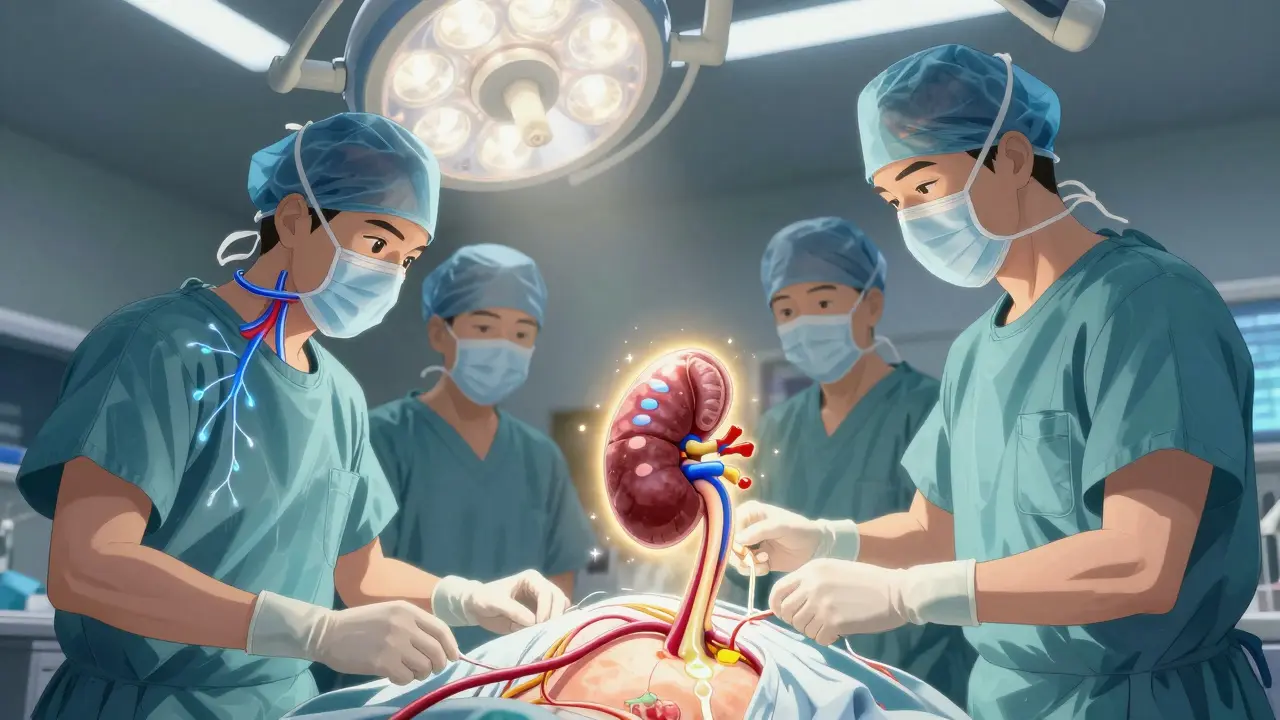
The Surgery: What Happens During the Procedure?
The surgery itself takes 3 to 4 hours. You’ll be under general anesthesia. The surgeon places the new kidney in your lower belly-not where your old kidneys are. Your own kidneys usually stay in place unless they’re causing infections, high blood pressure, or pain.The new kidney’s blood vessels are connected to your main artery and vein. The ureter-the tube that carries urine-is attached to your bladder. It sounds complex, but surgeons do this thousands of times a year. In most cases, the kidney starts making urine right away. But about 20% of kidneys from deceased donors don’t work immediately. That’s called delayed graft function. You might need dialysis for a few days or weeks until it kicks in.
Living donor transplants are the gold standard. They have better outcomes because the kidney is healthy, fresh, and matched perfectly. The National Kidney Registry reports a 97% one-year survival rate for living donor kidneys, compared to 93% for deceased donor kidneys. The donor can live a normal life with one kidney. There’s no evidence that donating shortens life or increases future kidney disease risk.
Life After Transplant: The Real Challenge
The surgery is just the beginning. The real work starts after you wake up.You’ll need lifelong immunosuppressants-meds that stop your immune system from attacking the new kidney. The standard combo? A calcineurin inhibitor (like tacrolimus), an antiproliferative drug (like mycophenolate), and a steroid (like prednisone). Some people get extra drugs at first, like antibodies given during surgery to prevent early rejection.
These drugs aren’t optional. Miss a dose? You risk rejection. Take too much? You get infections, diabetes, or even cancer. Side effects are real: tremors, high blood pressure, weight gain, hair loss, and increased risk of skin cancer. You’ll need regular blood tests to keep your drug levels just right.
Follow-up is strict. The first month? Weekly visits. Months 2-6? Monthly. After that? Every 3 months. You’ll always need yearly checkups. Blood pressure, kidney function, and medication levels are tracked forever. Even if you feel fine, skipping appointments can cost you the transplant.
Survival rates tell the story: 95% of living donor transplants work after one year. After five years, 85% are still going strong. Deceased donor kidneys? 92% survive the first year. Five-year survival drops to 78%. That gap isn’t just numbers-it’s quality of life. People who get living donor transplants return to work faster, travel more, and live longer.
New Advances Changing the Game
The system isn’t perfect, but it’s getting better. The Kidney Donor Profile Index (KDPI), used since 2014, helps match kidneys to the right patients. A high-KDPI kidney comes from an older donor or someone with health issues. It might not last as long-but it’s still better than dialysis. A 2022 study in the American Journal of Transplantation showed that even high-KDPI kidneys improve life expectancy by years compared to staying on dialysis.Researchers are also working on tolerance. The dream? No lifelong drugs. Clinical trials at Stanford and the University of Minnesota are testing ways to train the immune system to accept the new kidney without suppressing it. Early results are promising. Within the next decade, we might see patients off immunosuppressants entirely.
Organ preservation is improving too. New machines that keep donor kidneys alive and oxygenated during transport are boosting success rates, especially for kidneys that used to be considered too risky.
What Comes Next?
If you’re on dialysis or close to it, talk to your nephrologist about a transplant evaluation. Don’t wait until you’re desperate. The process takes months. You’ll need tests, interviews, and sometimes lifestyle changes. But if you qualify, a transplant can give you back years of life you didn’t know you were missing.It’s not easy. But for thousands of people each year, it’s the best choice they’ve ever made.
Can I get a kidney transplant if I’m over 70?
Yes, age alone doesn’t disqualify you. Centers like UCLA evaluate older patients based on overall health-not just age. Frailty, heart function, lung capacity, and mental clarity matter more than your birth year. If you’re active, independent, and have strong support, you can be a candidate even in your 70s or 80s.
Do I have to be on dialysis before I can get a transplant?
Not always. Many centers now evaluate patients before they start dialysis, especially if their kidney function is declining fast (GFR dropping more than 10 mL/min per year). Getting a transplant before dialysis can lead to better long-term outcomes. But you still need to meet other eligibility criteria like BMI, heart health, and absence of active infections or cancer.
How long do transplanted kidneys last?
Living donor kidneys last longer-on average 15 to 20 years. Deceased donor kidneys last about 10 to 15 years. These are averages. Some last 25+ years. Factors like medication adherence, blood pressure control, avoiding smoking, and regular checkups play a huge role. Rejection, infections, and complications from immunosuppressants are the main reasons kidneys fail over time.
Can I drink alcohol after a kidney transplant?
Moderate alcohol is usually allowed-no more than one drink per day for women, two for men. But heavy drinking is dangerous. Alcohol can damage the new kidney, interact with immunosuppressants, and raise your risk of liver disease and cancer. Always check with your transplant team. Some centers require complete abstinence, especially if you have a history of alcohol abuse.
What happens if my transplanted kidney fails?
If the transplant fails, you return to dialysis. You can be re-listed for another transplant if you’re still healthy enough. Many people get a second transplant. Survival rates for second transplants are still good, especially if the first one lasted several years. The key is staying in care and keeping your body as healthy as possible between transplants.





Comments
Just read through this whole thing and honestly? It’s one of the clearest breakdowns I’ve seen. I’ve got a cousin on dialysis for five years now, and seeing the numbers on living donor vs deceased donor survival rates actually gave me hope. I didn’t realize how much better the outcomes are if you get it before dialysis even starts. My cousin’s GFR is dropping fast-like 8 points a year-and I’m going to push her to get evaluated ASAP. No more waiting until she’s miserable.
Also, the part about frailty over age? That hit home. My uncle’s 78, walks 3 miles a day, cooks for his whole family, and still drives himself to appointments. He’s got more life left than half the people half his age. They should stop treating age like a hard cutoff. It’s not about the number on your birth certificate-it’s about whether your body can still fight.
And yeah, the immunosuppressants? Brutal. But I’d take the tremors and the weight gain over another decade of dialysis. You’re not just surviving-you’re living. That’s the difference.
This is all just corporate propaganda. Transplants are a money grab. You think they care if you live? They care if you keep paying for meds for the rest of your life. Those drugs cost thousands a month. Insurance companies love this because it locks you in for decades. And don’t get me started on the waiting lists-how many people die waiting while organs go to rich folks who can pay for private evaluations? This isn’t medicine. It’s a business model dressed up as hope.
great info but u forgot to mention that some people get kidney from dead people who had diabites and that can cause probelms later. also i heard in india they dont do transplants for over 65 unless family is rich. not sure if true but worth checking.
They say ‘no active cancer’ but what counts as active? What if you had a basal cell carcinoma removed two years ago? What if it was in situ? What if the biopsy report was misread? And how do they define ‘cancer-free’? One center says five years, another says two. Who’s lying? And why are they not publishing their internal criteria? This whole system is a black box. You’re not being evaluated-you’re being screened for eligibility by a set of rules that change depending on which hospital you walk into. That’s not healthcare. That’s lottery.
Wow. Just wow. They say 'you need a care partner' like it's a nice suggestion. What if you're alone? What if you have no family? What if your friends all have their own lives? They don't care. They'll just say 'sorry, no backup, no transplant.' That's not medical ethics-that's eugenics wrapped in a clipboard. And the part about 'mental illness disqualifies you'? What if you're depressed because you're on dialysis? Is that a symptom or a disqualifier? They're not healing people. They're filtering out the 'unworthy.'
Also, why is alcohol allowed but weed isn't? Both are metabolized by the liver. Both interact with tacrolimus. One is legal, the other isn't. That's not science. That's politics.
There’s a quiet dignity in how this system operates-not because it’s perfect, but because it tries. The fact that we can transplant organs, that we’ve learned to suppress rejection, that we now track KDPI scores and preserve kidneys with oxygenated machines-it’s a triumph of collective human ingenuity. But we must also acknowledge the moral weight of who gets to live, and who doesn’t.
Eligibility criteria aren’t arbitrary. They’re born from decades of data, of lives lost to rejection, of organs wasted because the recipient couldn’t tolerate the regimen. We must balance compassion with realism. A transplant isn’t just a medical procedure-it’s a social contract. The recipient must be able to honor it.
And yet… what if the system excludes not because of risk, but because of loneliness? What if we’re turning away people who could thrive, not because they’re medically unfit, but because society hasn’t given them a community? Maybe the real innovation isn’t in the organ, but in how we care for the whole person.
This is an exceptionally well-researched and comprehensive overview. I work in nephrology and can confirm every data point mentioned here. The survival rates for living donor transplants are consistently higher across all major registries, and the 97% one-year survival figure is accurate. The emphasis on frailty assessment over chronological age is also aligned with current guidelines from the American Society of Transplantation.
One critical point not emphasized enough: pre-emptive transplantation-before dialysis-is associated with a 30% lower mortality risk over five years compared to starting on dialysis first. This is not a marginal benefit. It is life-altering. If you’re approaching GFR < 20, you need to be evaluated now-not later.
Also, the new perfusion devices (like the OrganOx Metra) are revolutionizing deceased donor outcomes. Kidneys that previously had >40% discard rates are now being successfully transplanted with >90% function at one year. This is real progress.
While the clinical information presented is accurate and well-structured, I would like to respectfully highlight the ethical implications of the care partner requirement. Requiring a designated individual to ensure medication adherence and follow-up appointments inadvertently penalizes individuals who are socially isolated, economically disadvantaged, or members of marginalized communities. This is not a medical limitation-it is a systemic inequity.
Transplant centers should be investing in telehealth monitoring, medication adherence technology, and community-based support networks rather than relying on informal familial structures that may not exist. The goal should be to enable access, not gatekeep it through social capital.
Let me tell you something nobody else will: the real reason people get denied is because they’re not ‘compliant enough.’ They don’t say it outright, but if you miss one appointment, they start looking for reasons to kick you off the list. I know a guy who got turned down because his wife said he forgot to take his meds once. He had a job, a house, a kid-he just had a bad week. But now he’s on dialysis for life. That’s not medicine. That’s punishment disguised as precaution.
And don’t get me started on the ‘6 months clean’ rule for substance use. What if you used weed to manage chronic pain? What if you drank because your wife died and you couldn’t sleep? They don’t care about your story. They just want a checkbox. That’s why so many people give up before they even start.
Transplant > dialysis. Period. I’ve seen friends go from wheelchair to hiking trails in six months. It’s not magic-it’s biology. One kidney does the job of two. Your body wasn’t built to be hooked up to a machine. It was built to move, to feel, to live. This isn’t just survival. It’s liberation. Get evaluated. Even if you’re scared. Even if you’re old. Even if you’re overweight. Do it. Your future self will thank you.
man i had a cousin get a transplant last year and wow. the meds made him gain 50 lbs and his hair fell out but he went back to work and took his grandkid fishing for the first time. that’s worth it.
also don’t let anyone tell you you’re too old. my uncle was 74 and they said no at first, then he lost 20 lbs and walked 2 miles a day for 3 months and they said yes. he’s been good for 2 years now. just don’t give up.
and yeah, alcohol? one beer now and then is fine. but if you’re gonna drink like it’s a competition? nah. that kidney ain’t gonna last.
Everyone’s talking about survival rates and eligibility like it’s a science. But let me tell you what really happens behind the scenes: hospitals are pressured by insurance companies to clear beds and reduce costs. A transplant is profitable. Dialysis? That’s a cash cow. They want you to get the transplant not because they care about your life-but because it’s cheaper for them to pay for one surgery than twenty years of weekly treatments.
And the ‘care partner’ rule? That’s not about safety. That’s about shifting responsibility. If you don’t have someone to hold your hand, you’re not worthy. You’re a burden. And that’s the truth they won’t say out loud.
Also-why is a 75-year-old with diabetes and hypertension disqualified, but a 50-year-old with a history of cocaine use and two DUIs gets approved? Because he has a sister who works in the hospital? That’s not medicine. That’s corruption.