
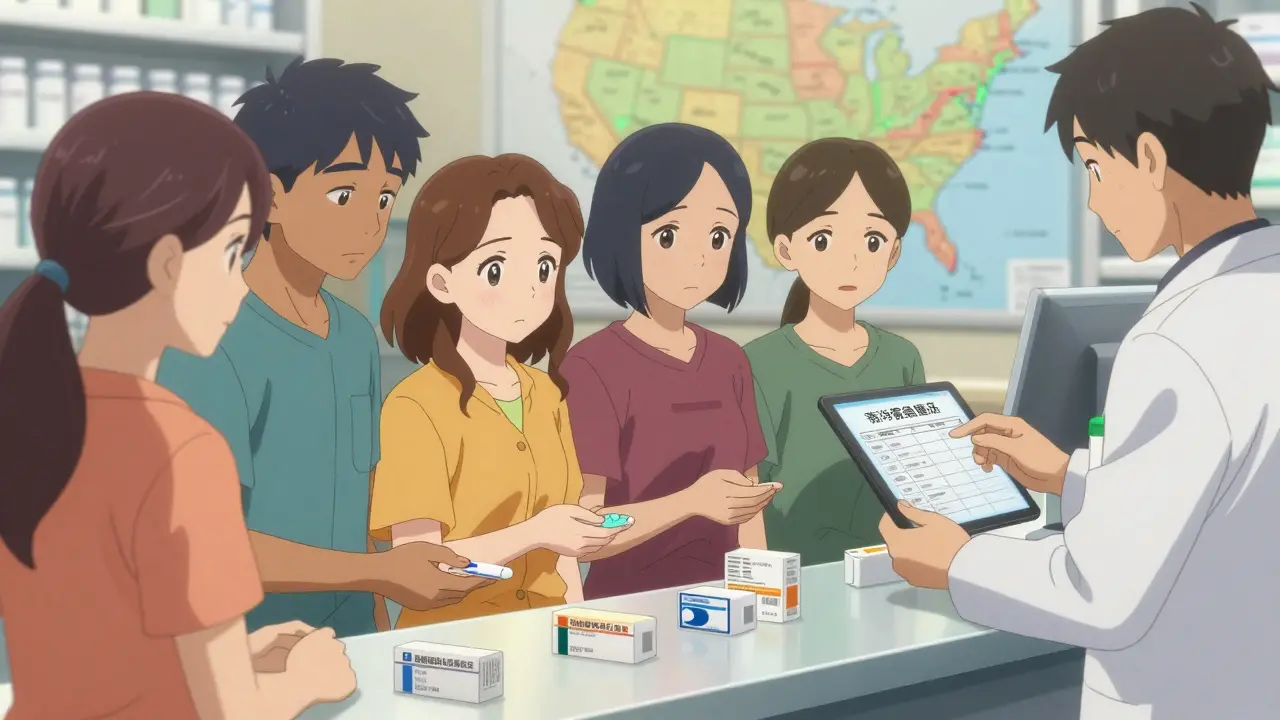
When you pick up a prescription, you might not realize that the pill in your bottle wasn’t the one your doctor wrote on the script. That’s because in most states, pharmacists are allowed - or even required - to swap brand-name drugs for cheaper generic versions. But here’s the catch: every state has different rules. Some force the swap. Others leave it up to you. A few don’t even tell you it happened. If you’re a patient, a pharmacist, or just someone trying to save money on meds, understanding these laws isn’t optional - it’s essential.
How Generic Substitution Works (And Why It Matters)
Generic drugs are chemically identical to their brand-name counterparts. They work the same way, have the same side effects, and are held to the same FDA standards. The only real difference? Price. Generics cost, on average, 80-85% less. From 2008 to 2017, they saved the U.S. healthcare system over $1.68 trillion. That’s not a small number. It’s the difference between a family paying $50 or $500 for a month’s supply of blood pressure medication.
But here’s where it gets messy. Even though the FDA says generics are interchangeable, states control whether pharmacists can actually make the swap. Some states say: “You must substitute unless the doctor says no.” Others say: “You can substitute, but only if the patient agrees.” And a few say: “Do whatever you want - we don’t care.”
That means two people with the same prescription, living just across a state line, could get completely different treatment. One gets the generic automatically. The other gets the brand name - and pays three times as much.
Mandatory vs. Permissive Substitution Laws
There are only two real models: mandatory and permissive.
19 states have mandatory substitution laws. In these places, pharmacists must switch to a generic unless:
- The prescriber writes “dispense as written” on the prescription
- The patient refuses
- The drug isn’t rated as therapeutically equivalent by the FDA’s Orange Book
These states include California, New York, Florida, Texas, and Illinois. In them, generic use is 8.7% higher than in permissive states. That’s not just a number - it’s real savings. In California alone, the average prescription cost dropped 5.2% after mandatory substitution kicked in.
The other 31 states plus Washington, D.C. use permissive substitution. Here, pharmacists can substitute - but they don’t have to. Many do, especially if the patient is on a high-deductible plan or the insurer pushes for generics. But if the pharmacist is unsure, or if the patient seems hesitant, they might just give the brand name. That’s fine legally - but it costs patients money.
What States Require You to Know Before the Swap
Some states believe you have a right to know when your drug changes. Others think it’s none of your business.
Only 7 states and D.C. require explicit patient consent before substitution. That means the pharmacist has to stop, explain the change, and get you to say “yes.” Those states are: Connecticut, Maine, Massachusetts, Minnesota, New Hampshire, Oregon, Rhode Island, and D.C. In those places, patients are 68% more likely to say they felt informed about their meds.
In contrast, 20 states don’t require any notification at all. You could be handed a different pill, with no warning, no label change, no conversation. You might not even notice - until you get a surprise bill or your blood pressure spikes because the new generic didn’t work the same way for you.
Biologics Are a Whole Different Ballgame
Not all drugs are created equal. Small-molecule generics (like metformin or lisinopril) are chemically identical to their brand names. But biologics - drugs like Humira, Enbrel, or insulin - are made from living cells. They’re complex. And because of that, 45 states treat them differently.
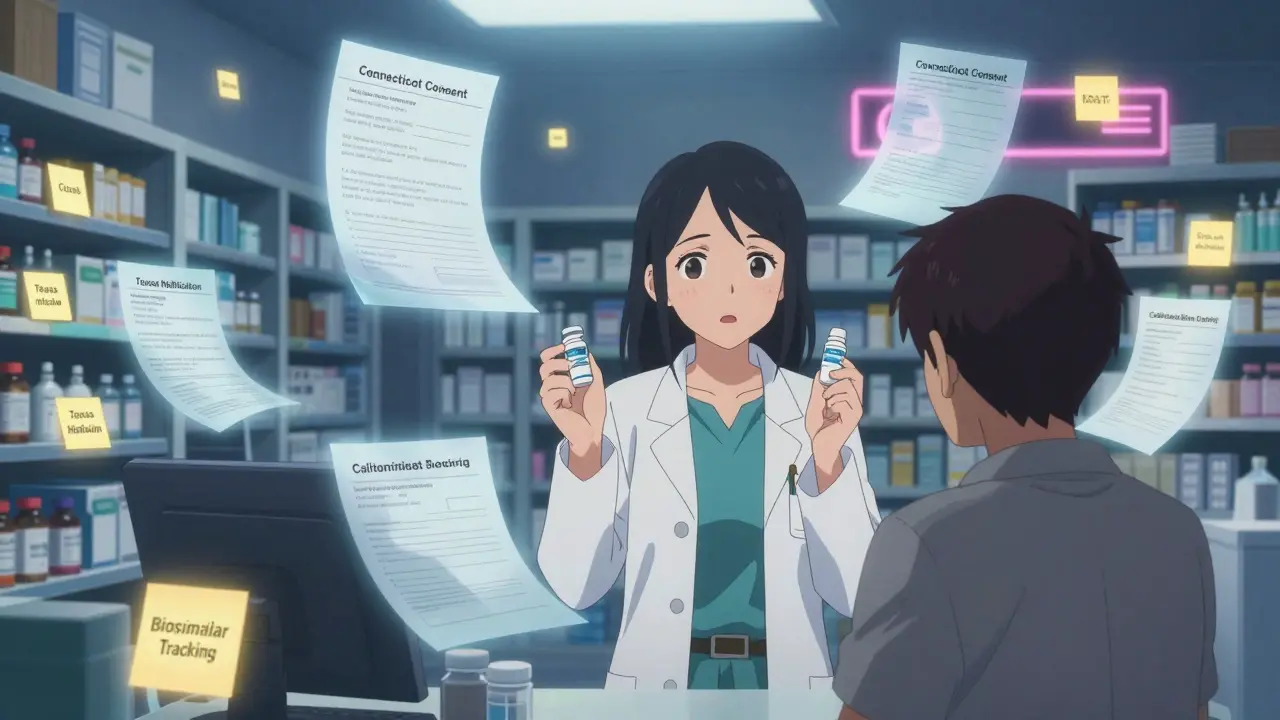
For biologics, substitution isn’t automatic. Even if the FDA approves a biosimilar (the generic version of a biologic), most states require:
- Physician notification within 5-10 days
- Patient consent before switching
- Electronic records tracking the change
California requires the pharmacist to make an electronic entry in the prescriber’s system within 5 days. New York requires a written note. Texas requires both. And in 12 states, the prescriber must re-authorize the substitution every time.
As a result, biosimilar adoption is stuck at 14.3% of eligible prescriptions - even though 32 have been approved. Compare that to small-molecule generics, which are used in over 90% of cases. The reason? State laws are holding them back.
Who’s Protected? Who’s at Risk?
Pharmacists are on the front line. But in 24 states, they have no legal protection if something goes wrong after a substitution. That means if a patient has a bad reaction, the pharmacist could be sued - even if they followed every rule.
Meanwhile, 26 states give pharmacists explicit liability protection - as long as they follow state law. That’s a big deal. In Connecticut, one pharmacist told Pharmacy Times she refused to substitute warfarin (a blood thinner) because she didn’t want to risk being sued. She knew the generic was approved - but without legal protection, she played it safe. And the patient paid more.
That’s the hidden cost of patchwork laws: safety gets sacrificed for legal fear.
How Pharmacists Really Navigate This Mess
Most pharmacists don’t memorize 50 sets of rules. They use tools - but even those aren’t perfect.
A 2024 survey found that 63% of pharmacists rank “navigating varying substitution laws” among their top three administrative burdens. One pharmacist on Reddit said she spends 15-20 minutes a day just checking rules for telepharmacy work across three states. That’s not patient care - that’s paperwork.
Only 28 states have fully integrated substitution rules into electronic health records (EHRs) like Epic or Cerner. That means in 23 states, pharmacists still have to manually check state websites, call pharmacies in other states, or print out PDFs from the National Association of Boards of Pharmacy (NABP). The NABP’s free online resource is helpful - but 53% of pharmacists say it’s too vague for biologics.
Some tech is helping. The ScriptPro SP 200 system now auto-updates state rules in real time. Pharmacies using it saw a 37% drop in substitution errors. But that system costs money - and most independent pharmacies can’t afford it. Chain pharmacies? They have the budget. Independent ones? They’re left guessing.
What This Means for Patients
If you’re on a chronic medication - like insulin, thyroid pills, or antidepressants - a switch can change your life. Sometimes, generics work perfectly. Other times, they don’t. And without knowing what changed, you might never realize why.
Patients in states with consent laws are more informed. But patients in states without notification? They’re flying blind. A 2021 study found that 22% of substitution-related medication errors happened in states that didn’t require notification.
Here’s what you can do:
- Always ask: “Is this the same as what my doctor prescribed?”
- Check the pill’s shape, color, and imprint - generics often look different
- If you feel different after a refill, tell your doctor - and ask if a substitution happened
- Request a “dispense as written” note if you’ve had bad experiences with generics before
The Future: Will States Ever Agree?
Right now, we have 51 different systems - 50 states plus D.C. Each one has its own formulary, its own rules, its own exceptions. It’s inefficient. It’s expensive. And it’s dangerous.
There’s movement toward change. The National Association of Boards of Pharmacy launched a project in January 2024 to reduce the 51 systems down to just three regional models by 2026-2027. The FDA is pushing for alignment too. Commissioner Robert Califf called state law fragmentation “the single greatest barrier to biosimilar adoption.”
But change is slow. In 2023-2024, 17 states introduced reform bills. Only 9 passed them - and most of those just aligned biologic rules with small-molecule rules. The rest? Still stuck in their own worlds.
Without national standards, the system will keep favoring big pharmacy chains over independents. It will keep patients in the dark. And it will keep us from saving billions more in drug costs.
For now, the only thing you can control is your own awareness. Know your state’s rules. Ask questions. Push back when needed. Because when it comes to your meds, no one else will.
Can a pharmacist substitute my brand-name drug without telling me?
Yes - in 20 states, pharmacists are not required to notify you before substituting a generic drug. They can swap it out as long as the drug is FDA-approved as equivalent. You won’t see a note on your label, and you won’t be asked. If you want to know, you have to ask.
Are all generic drugs interchangeable with brand names?
The FDA says yes - if they’re rated “A” in the Orange Book. But some patients report differences in effectiveness or side effects. While rare, these cases happen. If you feel worse after a switch, talk to your doctor. You may need to request “dispense as written.”
Do biosimilars follow the same rules as regular generics?
No. 45 states have stricter rules for biosimilars. Most require physician notification, patient consent, or electronic tracking. That’s because biosimilars are more complex than small-molecule generics. The FDA approves them, but states control how they’re used - and many treat them like new drugs, not replacements.
What does “dispense as written” mean?
It means the prescriber is asking the pharmacist not to substitute the drug with a generic. This is written on the prescription or entered electronically. If you see this on your script, you’ll get the brand name - even in states with mandatory substitution laws.
Can I refuse a generic substitution?
Yes - in every state. Even in states with mandatory substitution, you can say no. The pharmacist must honor your request. You may have to pay more out of pocket, but you have the right to choose.
Why do some states require patient consent while others don’t?
It’s a mix of politics, history, and patient advocacy. States with consent laws tend to have stronger consumer protection movements or were influenced by pharmaceutical lobbying. States without them prioritize cost savings and efficiency. There’s no medical reason for the difference - it’s purely policy.
How can I find out my state’s substitution rules?
The National Association of Boards of Pharmacy (NABP) offers a free online tool that maps state laws. You can also call your state board of pharmacy or ask your pharmacist. Keep in mind: rules change, and many tools don’t cover biologics well. Always verify with your provider if you’re switching a high-risk medication.
What’s Next for You?
If you’re a patient: Check your last prescription. Did you get the same pill? If not, ask why. If you’re on insulin, warfarin, or epilepsy meds, never assume the generic is identical. Track how you feel.
If you’re a pharmacist: Use tools like ScriptPro or your state’s EHR system - but don’t rely on them alone. Double-check the Orange Book. Know your liability. And if your state doesn’t protect you, advocate for change.
If you’re a policymaker: Fragmented laws aren’t helping anyone. They’re costing patients money, confusing pharmacists, and slowing down biosimilar adoption. Harmonization isn’t just smart - it’s necessary.
Generic drugs save lives. But only if you know when they’re used - and who’s allowed to change them.





Comments
Let me get this straight - America lets pharmacists swap life-saving meds like they’re trading baseball cards? And you call this a free market? In India we don’t mess around - if your doctor prescribes it, you get it. No ‘consent’ nonsense. This whole system is just corporate greed in a white coat. Generic drugs are cheaper because Big Pharma wants you addicted to their overpriced brand names. They don’t care if you live or die - only if you pay. Stop pretending this is about healthcare. It’s about profit. And it’s disgusting.
Wait… so you’re telling me the government doesn’t even tell you when they switch your meds? That’s not a mistake - that’s a covert operation. Who’s behind this? Pharma? The FDA? The Illuminati? I’ve been on levothyroxine for 12 years and I swear my mood changed after one refill. I didn’t know they swapped it. Now I think my depression wasn’t mental - it was chemical sabotage. Someone’s testing us. And we’re all just lab rats in a pill bottle.
Oh honey. Let me just say - I love how we’ve turned something as simple as ‘take this pill’ into a 10-part Netflix documentary. You know what’s wild? People spend 20 minutes arguing about whether their blood pressure med is generic… but won’t check their own sugar intake. I get it - it’s scary to not know what’s in your body. But maybe the real issue isn’t the pharmacist… it’s that we’ve been trained to distrust everything. Even medicine. And that’s kinda tragic.
The FDA says generics are equal but states say nope and now pharmacists are stuck in a legal maze. Some states make you beg for consent others just hand you the generic like its a coupon. This isnt healthcare its a bureaucratic nightmare. I work in pharmacy and I have to check 3 different systems just to fill one script. Its 2024 not 1994. Fix this. Or let the market do it. Either way stop pretending this is about safety its about control.
Every pill is a silent conversation between science and society. We think we’re just taking medicine - but really, we’re participating in a system built on trust, fear, and profit. In India, we say ‘Jeevan hai, dawa hai’ - life exists, medicine exists. But here, it feels like medicine is a transaction. And when we lose the human element - the trust, the dialogue - we lose more than money. We lose dignity. Maybe the real solution isn’t in laws… but in asking: ‘Who are we trying to protect? And at what cost?’ 🌿💊
Okay, but can we just take a moment to appreciate how much work pharmacists do? Like, imagine having to memorize 50 different rule sets and still keep your patients safe?? I’m so grateful for them. And also - if you’re on a chronic med, always ask for the pill’s imprint code! It’s on the pill, I promise. And if it looks different? Ask. Always ask. You’re not being difficult - you’re being smart. 💕
So let me get this: a guy in Texas gets his insulin generic without a blink, but a lady in Maine gets a full briefing and a pamphlet? It’s like we’ve got a medical Wild West out here - same drug, different rules, zero consistency. I get why states want control, but this isn’t federalism - it’s chaos with a pharmacy counter. Someone’s gotta unify this. Or we’ll keep having patients who don’t know why they feel weird after a refill. And that’s just… sad.
There’s a quiet hero in every pharmacy: the pharmacist who refuses to substitute warfarin even when the law allows it. They’re not being cautious - they’re being ethical. Because for some drugs, the difference between ‘equivalent’ and ‘effective’ is a single molecule. And that’s not just science - it’s survival. We need liability protection for pharmacists, yes - but we also need national standards. The patchwork isn’t protecting patients. It’s punishing them.
It’s absolutely astonishing, isn’t it? The sheer, labyrinthine absurdity of having 51 different regulatory frameworks governing something as fundamental as the substitution of life-sustaining pharmaceuticals - and yet, we’re told this is ‘local autonomy’? No. It’s incompetence dressed in bureaucratic finery. I’ve spent hours - literally hours - trying to decipher whether Oregon’s 2023 amendment to Section 475.220(b) overrides the 2019 NABP advisory on biosimilar labeling, and I still don’t know. And I’m not even a pharmacist. I’m just a guy trying to refill his antidepressants without having to file a Freedom of Information Act request. This system is not just broken - it’s a monument to institutional failure.
Look - I get the fear. I’ve been there. But here’s what I’ve learned: most generics work just fine. The ones that don’t? They’re rare. And if you’ve had a bad experience, that’s valid - but don’t let it make you distrust all of it. Talk to your pharmacist. Ask questions. Know your pill. And if you’re lucky enough to live in a state that asks your consent - cherish that. It’s rare. And it matters. We don’t need 50 systems. We need better communication. And maybe… a little more trust.