
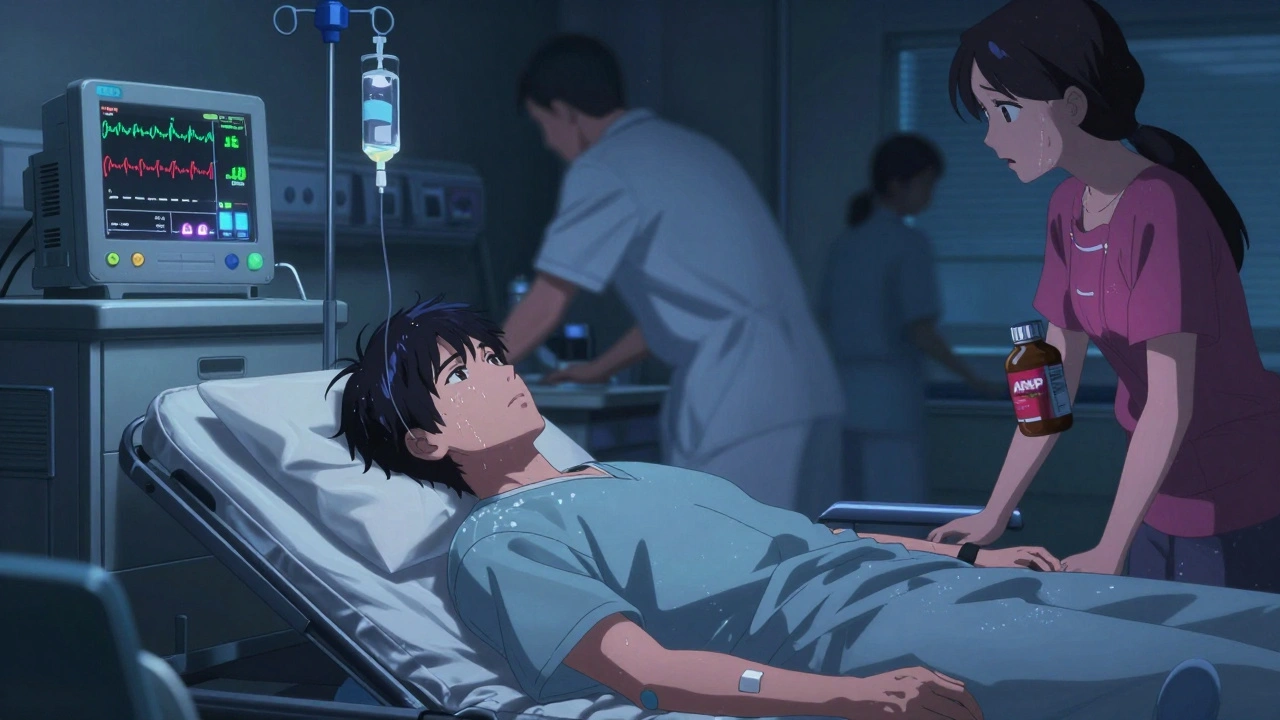
Every year, thousands of people end up in the emergency room because they took too much acetaminophen - the active ingredient in Tylenol and hundreds of other pain relievers and cold medicines. Many don’t even realize they’ve overdosed until it’s too late. The problem isn’t just taking a handful of pills at once. It’s often mixing medications, misunderstanding dosages, or thinking "more is better" when you’re in pain. The truth? Your liver can only handle so much. Beyond that, it starts shutting down - silently, fast, and sometimes without warning.
What Happens When You Take Too Much Acetaminophen?
Acetaminophen is safe when used as directed. But when you cross the line - even just a little - your liver gets overwhelmed. It breaks down the drug into a toxic byproduct called NAPQI. Normally, your liver uses glutathione to neutralize it. But when you take too much, glutathione runs out. NAPQI starts attacking liver cells, causing them to die. This isn’t a slow process. It can begin within hours.
The threshold? For most adults, it’s 4,000 milligrams in 24 hours. That’s eight 500 mg pills. But here’s the catch: many prescription painkillers like Vicodin or Percocet already contain acetaminophen. If you’re taking those and also reaching for Tylenol for a headache, you could easily hit 6,000 mg without meaning to. That’s why 68% of people who overdose don’t realize they’re at risk - they think they’re just taking "two different things."
Stage 1: The Silent Hours (0-24 Hours)
Right after an overdose, you might feel fine. Or you might feel a little nauseous. Maybe you vomit once. Some people don’t feel anything at all. This is the most dangerous phase. You’re not sick enough to go to the hospital, but the damage is already starting. About 30-40% of people show no symptoms in the first 24 hours. That’s why waiting for signs to appear is a deadly mistake.
Don’t wait for pain. Don’t wait for yellow skin. If you’ve taken more than the recommended dose - even if you feel okay - get checked. Every hour counts.
Stage 2: The Warning Signs (24-72 Hours)
By day two, your body starts screaming. Right upper abdominal pain - right under your ribs - becomes common. Nausea and vomiting return, often worse than before. Your liver enzymes, especially ALT, begin to spike. Normal levels are between 7 and 56 IU/L. In overdose cases, they can climb above 1,000 IU/L. This is when labs start showing trouble.
At this stage, many people still think it’s just the flu or a stomach bug. They delay care. But this is the window where treatment can still reverse the damage. If you took acetaminophen in the last 24-48 hours and now have unexplained pain or vomiting, go to the ER. Don’t call your doctor. Don’t wait for morning. Go now.
Stage 3: The Crisis (72-96 Hours)
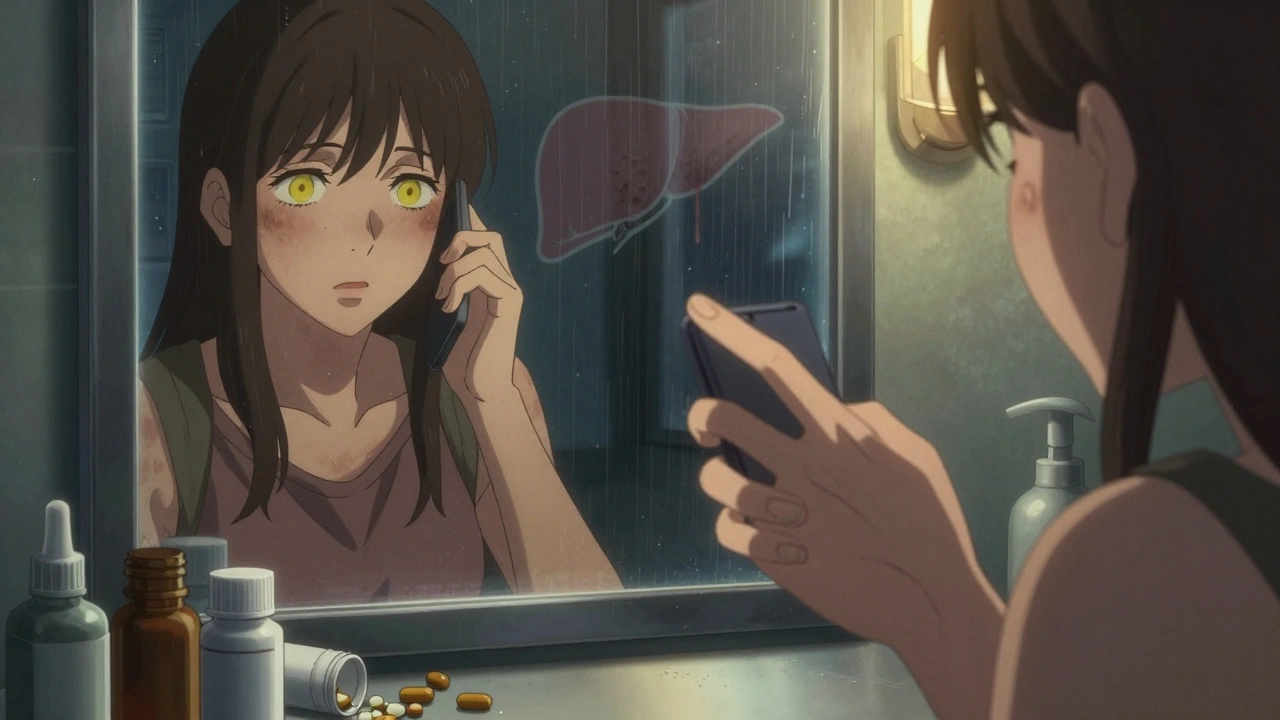
If you’ve made it this far without treatment, things get serious fast. Your liver is failing. Jaundice - yellowing of the skin and eyes - appears in over 90% of severe cases. Your blood can’t clot properly, leading to bruising or bleeding. Your kidneys start to shut down. Confusion, drowsiness, and even coma can happen. This is acute liver failure.
At this point, your INR (a blood clotting test) is likely above 1.5. Creatinine levels rise. Some patients develop pancreatitis. The mortality rate jumps to 25-40% without intervention. This isn’t a hospital stay. This is an ICU battle.

The Only Antidote: N-Acetylcysteine (NAC)
There’s one drug that can save your life: N-acetylcysteine, or NAC. It’s not a miracle cure - but it’s the only thing that works. NAC replenishes glutathione and binds to the toxic NAPQI before it destroys your liver.
Timing is everything. If you get NAC within 8 hours of taking too much, it’s 98% effective. Between 8 and 15 hours, effectiveness drops to 75%. After 15 hours, it’s only 55%. And every hour you wait increases your risk of death by 8.5%.
The standard IV dose is a 21-hour drip: 150 mg/kg over the first hour, then 50 mg/kg over the next four hours, then 100 mg/kg over the next 16 hours. Oral NAC takes longer - 72 hours of doses - and is harder to tolerate because it tastes awful and causes vomiting. That’s why IV is preferred in hospitals.
Even if you show up 24 hours after the overdose, NAC is still recommended. Studies show it can still help up to 48 hours later, especially if liver damage is already visible. Don’t let anyone tell you it’s "too late." Get it anyway.
What Else Happens in the ER?
When you arrive, they’ll check your acetaminophen level - but only if you’re within 24 hours of ingestion. They’ll plot it on the Rumack-Matthew nomogram. If the level is above 150 µg/mL at 4 hours, you get NAC. No exceptions.
If you took the pills within the last 1-2 hours, they might give you activated charcoal to soak up what’s left in your stomach. They’ll give you fluids through an IV. If you’re vomiting, they’ll give you ondansetron. If your blood won’t clot, they’ll give you vitamin K or fresh frozen plasma.
For those with severe liver failure, doctors use the King’s College Criteria to decide if you need a transplant. If your blood pH is below 7.3, your INR is over 6.5, and your creatinine is above 3.4 mg/dL - you’re in critical condition. Without a transplant, survival is nearly zero.
Who’s at Highest Risk?
Not everyone who overdoses has the same outcome. Some people are more vulnerable:
- Chronic alcohol users: Drinking regularly lowers glutathione levels and increases NAPQI production. Risk triples.
- People with hepatitis B or C: Their livers are already damaged. Overdose risk jumps 65%.
- Those on seizure meds: Drugs like phenytoin or carbamazepine speed up how fast your liver turns acetaminophen into poison.
- Malnourished individuals: Low protein intake cuts glutathione by 25-30%. This includes people with eating disorders, cancer, or HIV.
If any of these apply to you, your safe limit is far below 4,000 mg. Talk to your doctor about a lower maximum dose.
Recovery and Long-Term Outlook
Here’s the good news: if you get treated in time, your liver can heal. About 85-90% of patients who get NAC within 8 hours recover fully. Within three months, 92% of survivors have completely normal liver function.
But 8% still have mild, ongoing liver enzyme elevations. They need follow-up blood tests every few months. And if you needed a transplant? Survival rates are strong - 85% live at least five years after the procedure.
The economic cost? Around $38,500 per hospital stay in the U.S. That’s why prevention matters so much.
How to Prevent an Overdose
Here’s how to stay safe:
- Never take more than 4,000 mg in 24 hours - and even 3,000 mg is safer if you drink alcohol or have liver issues.
- Check every medicine label. Acetaminophen is in cold remedies, sleep aids, and prescription painkillers. Look for "APAP" on the ingredient list.
- Don’t combine Tylenol with other acetaminophen-containing drugs. Even one extra pill can push you over the edge.
- If you drink alcohol regularly, talk to your doctor about a lower daily limit - maybe 2,000 mg max.
- Keep pills locked up if you have kids or someone in the house with mental health struggles.
- If you’re unsure how much you’ve taken, call poison control or go to the ER. Better safe than sorry.
The FDA’s 2011 decision to cap prescription acetaminophen at 500 mg per pill cut liver failure cases by 21%. Education works. But it only works if people know.
What’s Next in Treatment?
Scientists are looking at new ways to protect the liver. Early research shows nitric oxide may help liver cells regenerate faster, even after the 8-hour window. Another promising area? MicroRNA-122, a biomarker that shows liver damage within two hours of overdose. In trials, it’s 94% accurate. That could mean faster diagnosis and earlier treatment - even before symptoms show.
For now, though, the rule is simple: if you think you’ve taken too much, don’t wait. Don’t hope it’ll pass. Go to the hospital. Your liver doesn’t have a backup plan. But NAC does.
Can you overdose on acetaminophen by taking too many cold medicines?
Yes, absolutely. Many cold, flu, and sleep medications contain acetaminophen. Taking Tylenol on top of NyQuil, DayQuil, or Vicodin can easily push you over the 4,000 mg daily limit. Always check the ingredient list for "acetaminophen" or "APAP."
If I feel fine after taking too much acetaminophen, do I still need to go to the hospital?
Yes. The most dangerous part of an overdose is that you often feel fine for the first 24 hours. Liver damage starts silently. Waiting for symptoms like vomiting or pain means you’re already in danger. If you’ve taken more than the recommended dose, get checked - even if you feel okay.
Is NAC safe to take at home without medical supervision?
No. Oral NAC requires precise dosing over 72 hours and can cause severe nausea and vomiting. IV NAC must be given in a hospital setting to monitor for allergic reactions and ensure proper dosing. Never try to self-treat an overdose.
How long does it take for liver damage to show up after an overdose?
Liver enzyme levels (like ALT) usually start rising between 24 and 48 hours after ingestion. Jaundice and other visible signs appear between 72 and 96 hours. But the actual damage begins within hours - it just doesn’t show up on tests or symptoms right away.
Can children overdose on acetaminophen too?
Yes. Children are especially vulnerable because dosing is based on weight. Giving a child adult-strength Tylenol, or giving multiple doses too close together, can cause severe liver damage. Always use the measuring device that comes with the medicine and follow weight-based charts.
Does drinking alcohol make acetaminophen more dangerous?
Yes. Regular alcohol use depletes glutathione, the liver’s natural defense against acetaminophen’s toxic byproduct. Even moderate drinking - three or more drinks a day - can triple your risk of liver damage from a normal dose of acetaminophen. Avoid alcohol entirely when taking it.
What should I do if I think someone I know has overdosed on acetaminophen?
Call emergency services immediately. Don’t wait for them to vomit or pass out. Bring the medicine bottle with you to the hospital so they know exactly what was taken. Time is the most critical factor - getting NAC within 8 hours saves lives.



Comments
Of course the FDA capped prescription pills at 500mg... because they’re scared of lawsuits, not because they care about your liver. Big Pharma’s been hiding this for decades. They knew acetaminophen was a silent killer, but they kept it in every damn cold med because it’s cheap and profitable. And now they want you to trust their ‘safe limits’? LOL. Wake up. They don’t want you healthy-they want you hooked on pills and coming back for more. #CorporateCoverup
From a pharmacovigilance standpoint, the NAPQI-glutathione axis is the critical metabolic bottleneck here. The kinetic saturation of hepatic phase II conjugation pathways is the mechanistic linchpin. NAC’s efficacy isn’t just anecdotal-it’s a direct glutathione precursor rescue pathway with a well-documented dose-response curve. We need standardized public health messaging around APAP exposure thresholds, especially in polypharmacy populations. This isn’t just clinical-it’s a systems-level failure in medication literacy.
Just wanted to say thanks for this. I had no idea mixing NyQuil and Tylenol could be this dangerous 😳. My mom does this all the time for her headaches. I’m sending her this right now. Please, everyone-check your labels. APAP = acetaminophen. It’s everywhere.
Wait-so if you’re on carbamazepine, and you’ve got a cold, and you take a Tylenol, and you’ve had a glass of wine, and you’re sleep-deprived, and you’re 60 pounds underweight-then you’re basically playing Russian roulette with your liver? And the only thing that saves you is a 21-hour IV drip that tastes like rotten eggs? And if you wait 16 hours, your chances drop to 55%? And no one tells you this until you’re in the ER? This isn’t a medical issue. This is a societal failure. We need warning labels on every single OTC product that contains APAP. Like cigarette warnings. Like ‘this kills.’
I’ve been on acetaminophen for 12 years for chronic pain… and now I’m terrified. I thought I was being careful. I never took more than 3,000 mg. But I also drank two glasses of wine every night. And I have hepatitis C. And I didn’t know any of this. I’m sitting here crying. My liver is probably already dead. Why didn’t anyone tell me? Why is this not on every prescription bottle? Why? Why? Why?
OMG I just checked my medicine cabinet and found 5 different things with APAP in them 😱 I’ve been taking 2 Advil Cold & Sinus and 1 Tylenol every night for my migraines… I’m so dumb. I’m throwing all of it out. Thank you for this. I’m telling my whole family. You saved my life.
so i just found out my cousin overdosed last week and they had to give her nac and she’s in the icu now and i had no idea it could happen from just cold meds?? like i thought it was just for people who take 20 tylenol at once?? this is wild. i’m gonna check all my meds now
People in this country are too lazy to read labels. I’ve seen it a hundred times-someone takes Tylenol, then takes a cold medicine, then says ‘I didn’t know!’ Well, you didn’t know because you didn’t care. This isn’t a medical crisis-it’s a cultural one. Stop being dumb. Your liver isn’t a magic box that fixes itself. And if you’re drinking and taking painkillers? You’re just asking for it.
Acetaminophen toxicity is a preventable tragedy. The data is clear. The antidote exists. The window is narrow. The solution is education. In India, we distribute leaflets at pharmacies. Simple. Direct. In English and local languages. No jargon. Just: ‘Check the bottle. Do not mix. One pill too many kills.’ We need this everywhere.
Why is this even a thing? People should just stop being idiots. If you take too much you die. That’s how it works. Why do we need a 2000 word essay on it? Just don’t take more than the bottle says. Done.
There’s a deeper truth here: we live in a culture that treats pain as a problem to be eliminated, not a signal to be understood. We reach for pills before we rest, before we stretch, before we breathe. We don’t ask why we hurt-we just want to stop hurting. And the system rewards that. But the liver doesn’t care about your schedule, your deadlines, your stress. It only cares about glutathione. And when that’s gone? There’s no app for that.
Thank you for writing this. I’m a nurse, and I’ve seen too many people come in thinking they’re fine because they ‘only took a few extra pills.’ I’ve held the hands of people who didn’t make it because they waited until their skin turned yellow. I’ve also seen people saved by NAC because someone brought them in at 3 a.m. with a bottle in hand. Please-don’t wait. If you think you might have taken too much, go. Even if you feel fine. Even if it’s 2 a.m. Even if you’re embarrassed. Your liver doesn’t care about your pride. It only cares about time. And time is the one thing you can’t get back.