
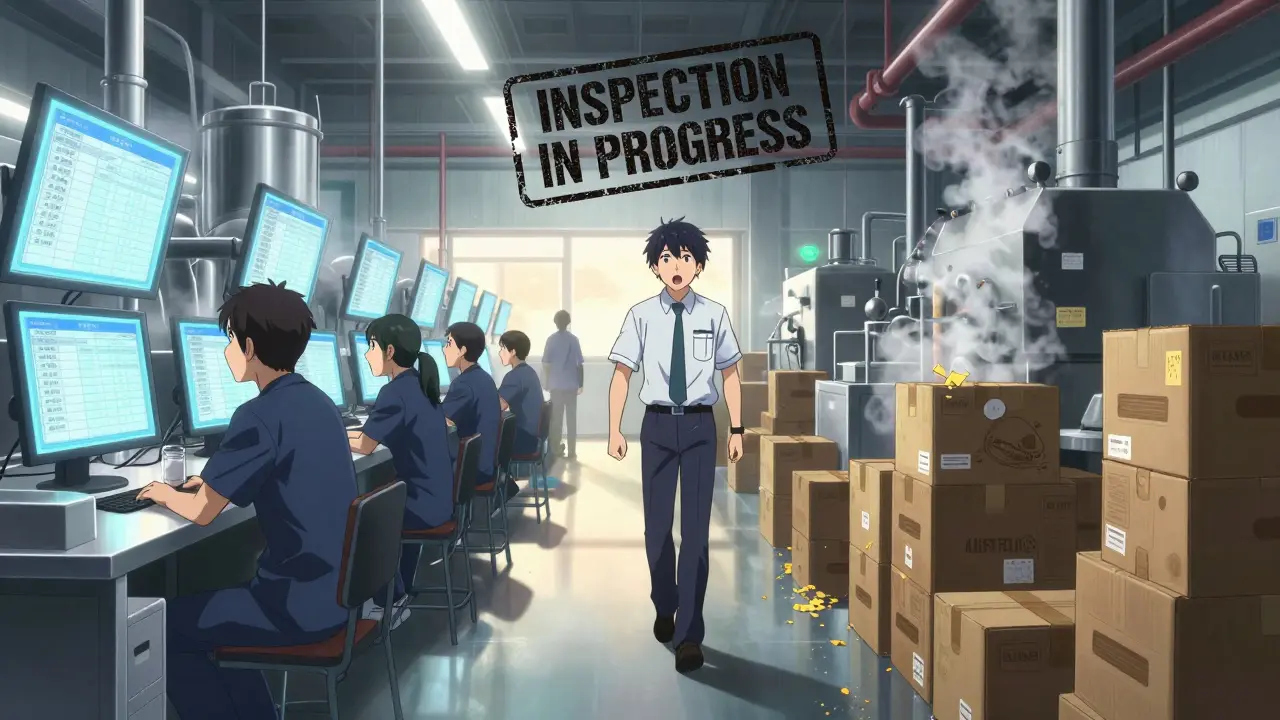
Every bite of food you eat that came from outside the U.S. passed through a system designed to catch contamination before it reaches your plate. That system? The FDA foreign facility inspection program. And since May 2024, everything changed.
Before, foreign food factories had a heads-up. Inspectors would call ahead. Companies would clean up, gather documents, hire translators, and prep for the visit. It was like giving someone a rehearsal before the big test. But now? No more warning. The FDA shows up when they want. No notice. No preparation window. And if you’re not ready? You risk having your product blocked from entering the U.S. - forever.
Why the FDA Changed the Rules
The shift wasn’t random. It was a direct response to a glaring double standard. While American food plants get unannounced inspections - sometimes with zero warning - foreign facilities were treated like guests. They got advance notice. They got help with travel. They got time to fix problems before inspectors arrived. Meanwhile, U.S. companies had to operate perfectly every single day, with no notice, no grace period.
FDA Commissioner Martin A. Makary called it out: “A double standard.” And he wasn’t alone. Food safety experts, watchdog groups, and even U.S. lawmakers had been pushing for years to close this gap. The logic is simple: if a factory in India produces food for Americans, it should meet the same standards as a factory in Ohio. No exceptions. No loopholes.
The legal backbone? The FDA Food Safety Modernization Act (FSMA), signed in 2011. It didn’t just update rules - it flipped the entire approach. Instead of waiting for outbreaks to happen, the FDA now tries to stop them before they start. That means inspecting facilities before their food even leaves the country.
Who Gets Inspected - And How
The FDA doesn’t inspect every foreign facility. There are over 300,000 registered food plants worldwide that export to the U.S. That’s one inspector for every 1,500 facilities. So how do they pick who to check?
It’s all about risk. Three things decide if your plant gets flagged:
- What you make - High-risk foods like sprouts, seafood, or raw nut butters get priority. Low-risk items like canned soda? Lower down the list.
- How you make it - Complex processes, like pasteurization, fermentation, or vacuum sealing, carry more danger. Simple packing? Less scrutiny.
- Your history - If your food got turned away at the border before? You’re on the radar. Repeated refusals? You’re next.
And here’s the kicker: the FDA doesn’t just look at the floor. They check your records. Your training logs. Your cleaning schedules. Your supplier approvals. Everything. If you can’t produce it in 15 minutes? That’s a violation.
What Happens If You Say No
Refusing an inspection isn’t a minor slip. It’s a federal offense.
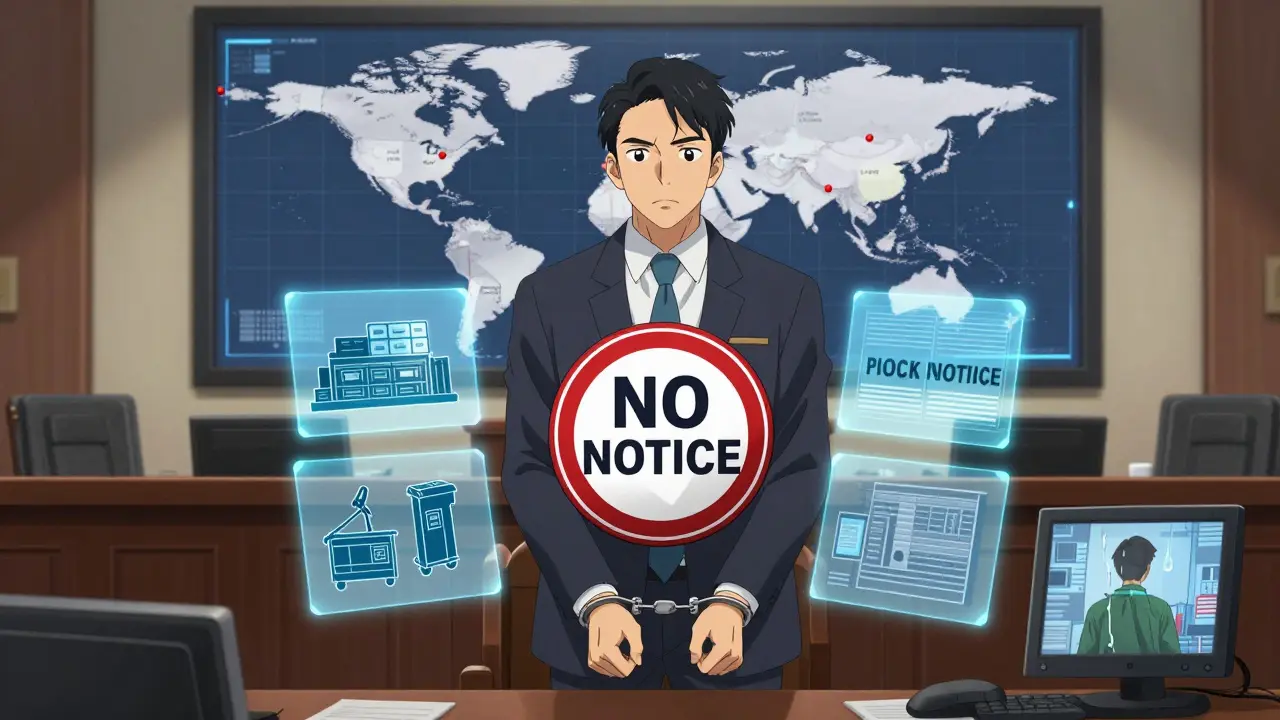
Under Section 306 of FSMA, if a foreign facility denies, delays, or limits an FDA inspection, the agency can - and will - refuse entry to all your products. No warning. No second chance. Just a denial notice sent to your customs broker.
But it gets worse. The FDA can refer your case to the U.S. Department of Justice. And yes - that means criminal charges. If your team hides documents, blocks cameras, or shuts down production to avoid inspection, you could face:
- Fines up to millions of dollars
- Forfeiture of equipment or inventory
- Debarment from exporting to the U.S.
- Exclusion from federal healthcare programs
There’s no “we didn’t know” defense. The FDA requires every foreign facility to certify during registration that they understand and accept this rule. You signed it. You agreed.
What Foreign Facilities Must Do Now
There’s no going back. Unannounced inspections are permanent. So what does that mean for a factory in Vietnam, Mexico, or Poland?
You need to be ready - every single day.
Here’s what that looks like in practice:
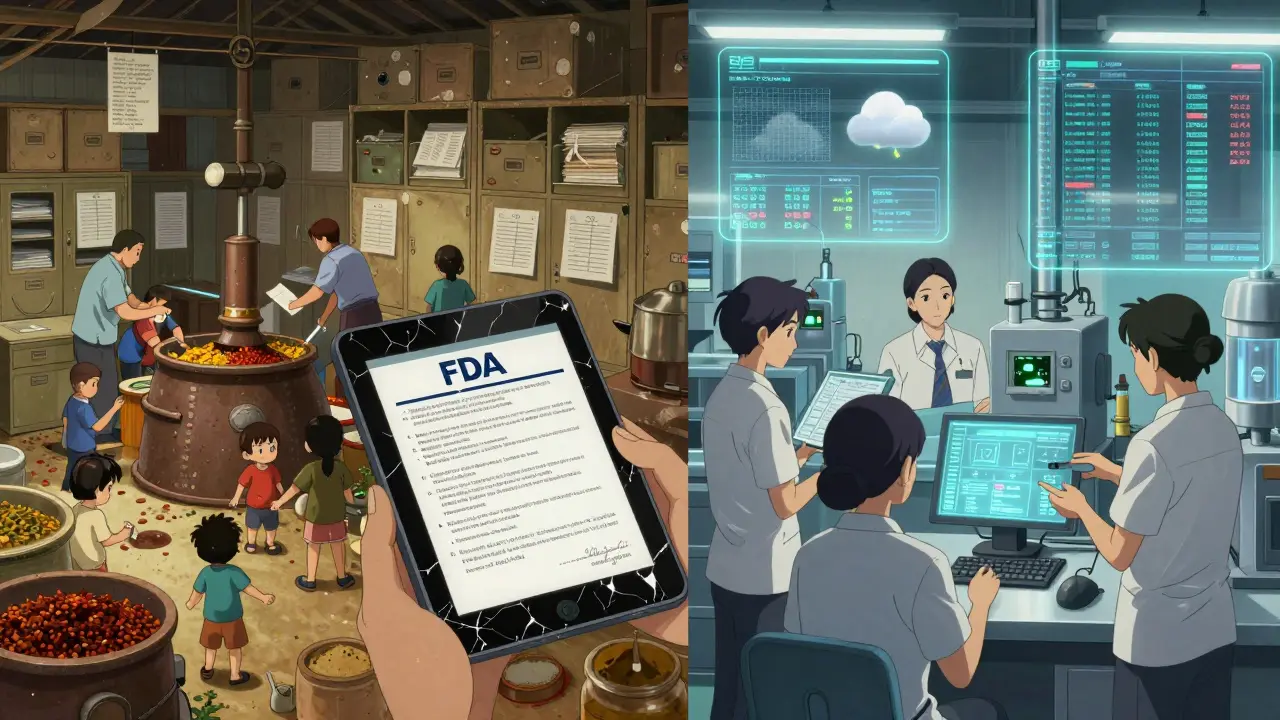
- Keep records accessible 24/7 - Digital systems are no longer optional. Paper files in a locked cabinet won’t cut it. Cloud-based documentation with real-time access is now the baseline.
- Train everyone - Not just managers. Floor workers, cleaners, maintenance staff. Everyone must know how to respond when an inspector walks in. What to say. What not to say. What documents to hand over.
- Have bilingual staff on-site - No more calling in translators the day before. If your team doesn’t speak English, hire someone who does. Full-time.
- Run mock inspections weekly - Pretend an FDA inspector just showed up. Can you pull up your last sanitation log? Can you show them how you track raw material sources? Can you explain your allergen controls? If not, fix it.
- Never accept help from the facility - The FDA now bans inspectors from accepting rides, meals, or lodging from the companies they inspect. That means no more company cars or hotel rooms. It also means you can’t “smooth things over.” You just have to be clean.
Companies that adapted fast - like large food manufacturers in India and China - started doing this years ago. Smaller producers? They’re still catching up. And that’s where the risk is highest.
The Real Challenge: Resources and Global Inequality
Let’s be honest: the FDA can’t inspect 300,000 facilities alone. Even with more staff, it’s impossible. So they rely on risk scoring, third-party audits, and data from customs rejections.
But here’s the problem - not all countries have the same infrastructure. A small family-run spice mill in Indonesia may not have cloud storage, trained quality staff, or English-speaking managers. Yet they still need to comply. The FDA doesn’t make exceptions for size or location.
That’s why some experts warn this policy could unintentionally hurt small exporters. They’re not dodging rules - they’re drowning in them. The system works well for big players with legal teams and compliance budgets. For others? It’s a wall.
Still, the FDA’s goal is clear: protect American consumers. And right now, 15% of the U.S. food supply comes from overseas. That’s 1 in 7 meals. And 32% of fresh produce. You can’t afford to ignore it.
What’s Next?
The FDA isn’t done. They’re testing new tools:
- Using AI to predict which facilities are most likely to fail based on past data
- Training local inspectors abroad to work under FDA oversight
- Linking inspection data directly to customs systems so refusals happen instantly
Expect more countries to be added to the “high-priority” list. India, China, and Mexico are already under heavy scrutiny. But look out for Thailand, Brazil, and Turkey - they’re next.
The message is simple: if you export food to the U.S., you’re no longer a guest. You’re a regulated supplier. And the rules are no longer negotiable.
Bottom Line
The FDA’s shift to unannounced inspections isn’t about punishment. It’s about fairness. If you sell food to Americans, you play by American rules - no exceptions. The days of advance notice are over. The only way to survive? Be ready. Always.
It’s not about being perfect one day a year. It’s about being perfect every day, every hour, every minute. Because when the FDA walks in - they won’t be asking for an appointment.
Do all foreign food facilities get inspected by the FDA?
No. The FDA inspects only a fraction of the over 300,000 registered foreign food facilities each year. They use a risk-based system that prioritizes facilities making high-risk foods (like seafood or sprouts), those with a history of product refusals, or those using complex manufacturing processes. Low-risk facilities with clean records may go years without an inspection.
What happens if a foreign facility refuses an FDA inspection?
If a foreign facility refuses, delays, or limits an FDA inspection, the agency can legally refuse entry to all of its products. That means shipments are blocked at the U.S. border and cannot be sold in the U.S. market. In serious cases - such as hiding records or blocking inspectors - the Department of Justice can pursue criminal charges, leading to fines, asset forfeiture, or even debarment from future exports.
Can the FDA inspect facilities without warning?
Yes. Since May 2024, the FDA has eliminated advance notice for foreign facility inspections, aligning them with U.S. domestic inspection standards. Inspectors now arrive unannounced, just like they do for American plants. Facilities must be prepared at all times to show compliance with U.S. food safety rules.
What documents should a foreign food facility keep ready?
Facilities must maintain current records on sanitation procedures, allergen controls, supplier approvals, training logs, and product testing results. These must be accessible immediately - either digitally or in print - during an inspection. The FDA requires proof that your facility follows Current Good Manufacturing Practices (CGMPs) under 21 CFR Part 117. Paper records stored in a locked office won’t suffice if they can’t be produced within minutes.
Is it legal for a foreign facility to hire a translator for FDA inspections?
Yes - but only if the translator is already on staff and available at all times. The FDA no longer allows facilities to arrange for translators on the day of inspection. You must have bilingual quality or compliance staff permanently on-site. Relying on temporary or phone-based translation services during an unannounced visit can be seen as an attempt to delay or limit the inspection - which could lead to enforcement action.



Comments
So let me get this straight - we’re now treating foreign food factories like they’re criminals on probation? 🤦♂️
Meanwhile, my local Walmart imports spinach from 12 countries and I’m supposed to trust this? We’re not fixing food safety - we’re just making global trade harder for small players. The FDA’s got a hammer, and now everything looks like a nail.
It is not merely a regulatory adjustment; it is a paradigmatic recalibration of epistemic authority in the global food supply chain. The prior system, predicated upon procedural indulgence, functioned as a structural asymmetry - one that privileged convenience over integrity. The FDA’s unilateral enforcement of unannounced inspections constitutes, in ontological terms, the imposition of a universal standard of accountability. This is not punitive; it is epistemologically necessary.
Look, I get why the FDA did this. Honestly. I do. But let’s not pretend this is just about fairness. It’s also about control. American regulators don’t want to be outsmarted anymore. They want to make sure no one can wiggle out of compliance. And honestly? That’s fair. But here’s the thing - a spice farm in Kerala doesn’t have IT staff. They don’t have cloud backups. They have a guy with a notebook and a phone that dies every other week.
So now what? Do we just say ‘too bad’? Do we let them go under because they can’t afford a compliance officer who speaks fluent English? This isn’t leveling the playing field - it’s bulldozing it and calling it ‘reform.’
And don’t get me started on the ‘bilingual staff on-site’ rule. You know how many small factories in Vietnam have full-time English speakers? Zero. Zero. And now they’re risking their entire business because the FDA decided ‘convenience’ was a loophole? This isn’t food safety. It’s regulatory colonialism.
As someone who’s worked in international food safety for over a decade, I’ve seen both sides. The old system was broken - no doubt. But the new one? It’s like telling a small bakery in Nepal they need to meet Michelin standards or get banned. The FDA’s heart is in the right place - protecting consumers - but the execution ignores reality.
What if we started with training grants? Or partnerships with local agencies? Instead of punishing the vulnerable, why not empower them? We’ve got the tech. We’ve got the expertise. Let’s help them adapt instead of just shutting them down.
So now I can’t buy curry paste from Thailand unless their guy with the clipboard speaks perfect English? Cool. I’m sure that’s why my last batch of noodles gave me a fever - because someone forgot to log the temperature of the sink. /s
Meanwhile, in America, we’re still eating chicken nuggets from a plant that had a rat problem last month. But hey - at least they got a heads-up.
I think people are missing the bigger picture here. This isn’t just about inspections. It’s about trust. For years, American consumers assumed that imported food was held to the same standard. But the truth? It wasn’t. And that’s why people get sick.
It’s not about being harsh. It’s about being honest. If you want to sell food here, you have to play by our rules. No exceptions. No favors. Not because we’re mean - because we’re responsible.
And honestly? The small factories that can’t keep up? Maybe they shouldn’t be exporting. That’s not cruel. That’s just reality.
Oh wow. So now the FDA is the global food police? Congrats, you just turned every small exporter into a criminal. I’m sure the guy in Bali who makes coconut oil in his garage is just thrilled to have to hire a full-time translator. He’s probably crying into his one working laptop right now.
Meanwhile, the big multinationals? They’ve got legal teams in 5 countries. This isn’t fairness - it’s a tax on being poor.
Hey - if you’re making food for Americans, you gotta be ready. No excuses.
But here’s the good news: you don’t need a fancy system. Just keep it clean. Train your team. Write things down. Practice. It’s not magic - it’s just discipline.
Small factories? You can do this. Start with one thing today. One log. One training. One checklist. You don’t need to fix everything tomorrow. Just start.
You got this.
Let’s be crystal clear: this is long overdue. And yet, somehow, people are acting like this is a tragedy? “Oh no! They can’t have translators on-demand!” Who cares? You’re not running a spa - you’re running a food facility. If you can’t handle an inspection without a 3-day notice, you shouldn’t be feeding people.
And don’t even get me started on the “small business” cry. If you can’t afford compliance? Then you shouldn’t be in this business. Period. End of story. No exceptions. No pity. Safety > sentiment.
While the FDA’s intent may be laudable, the implementation reveals a fundamental misunderstanding of global supply chains. The notion that a small facility in rural India must mirror U.S. regulatory infrastructure is not only impractical - it is epistemologically arrogant. Regulatory harmonization requires capacity building, not coercion. The FDA’s approach is not reform - it is imposition.
Let me tell you something - this isn’t about food safety. This is about America flexing its power. They’ve got their own factories under surveillance 24/7? Great. But now they want to control the entire world’s food supply? No. We’ve been producing safe food for centuries. We don’t need your English-speaking bureaucrats to tell us how to clean a floor.
You think we’re scared? We’ve got 1.4 billion people eating our food every day - and we haven’t had a single FDA-style inspection. We don’t need your rules. We’ve got our own standards. And they’re better than yours.