
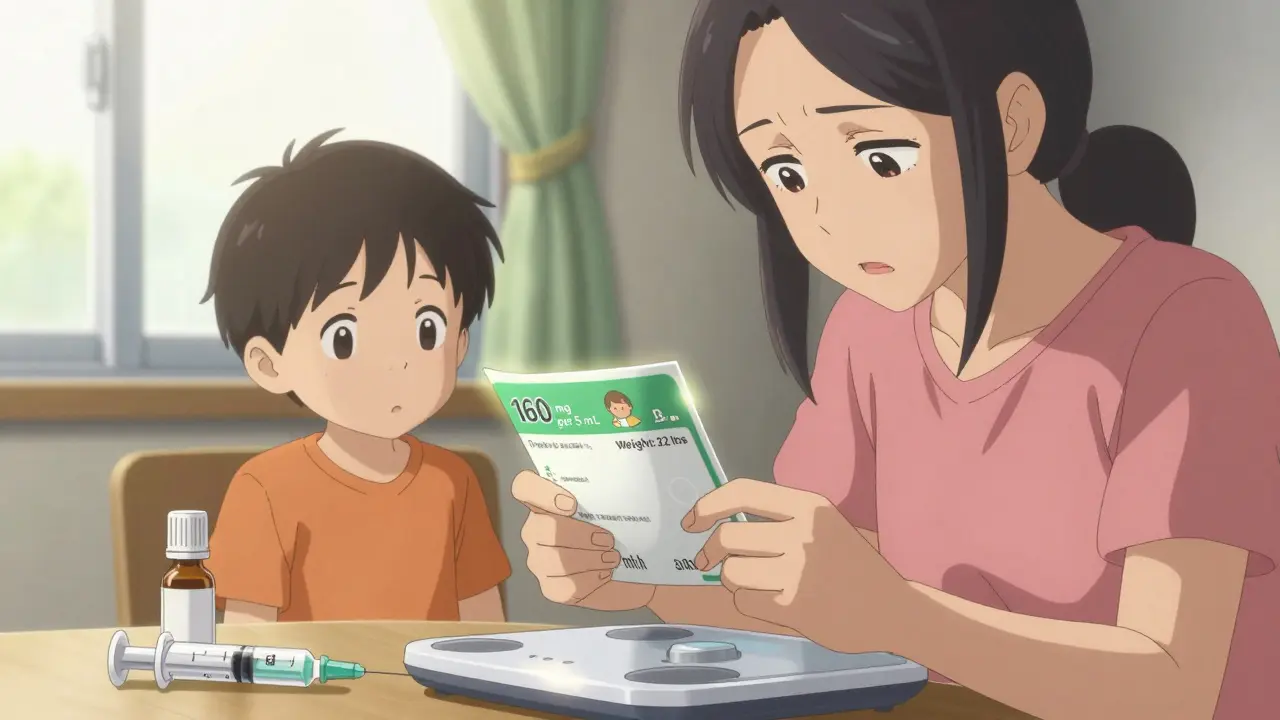
Why Reading Medicine Labels by Age and Weight Saves Lives
Every year, over 150,000 children in the U.S. end up in emergency rooms because of medication errors. Most of these aren’t accidents caused by carelessness-they’re mistakes made because parents didn’t know how to read the label correctly. It’s not about being bad at math or forgetting. It’s about confusing weight-based dosing with age-based charts, mixing up teaspoons and tablespoons, or using the wrong concentration of medicine. The truth? If you don’t read the label properly, you could be giving your child too much-or too little-of the medicine they need.
Here’s the reality: a 3-year-old who weighs 30 pounds needs a different dose than a 3-year-old who weighs 18 pounds. But if you just look at the age range on the bottle, you’ll give them the same amount. That’s dangerous. The American Academy of Pediatrics says weight is the gold standard for dosing. Age is only a backup when you don’t know the weight. And yet, most parents still rely on age. That’s why so many errors happen.
The Seven Parts of a Children’s Medicine Label (And What They Mean)
Every over-the-counter children’s medicine has a Drug Facts label. It’s not just filler text. It’s your safety guide. Here’s what each section means:
- Active ingredient: This tells you what’s actually working in the medicine. For fever or pain, it’s usually acetaminophen or ibuprofen. Look for the concentration: 160 mg per 5 mL. That’s the standard now. But don’t assume-some older bottles or generic brands might still use different numbers.
- Uses: This tells you what the medicine treats. Fever? Cough? Allergies? Don’t use it for something it’s not meant for.
- Warnings: This is critical. It tells you when NOT to give the medicine. For example, “Do not use in children under 2 years without doctor’s advice.” Or “Do not use with other products containing acetaminophen.” Many overdoses happen because parents give Tylenol and a cold medicine at the same time-both have acetaminophen.
- Directions: This is where you find the dosing instructions. Look for both age and weight ranges. Weight is listed in pounds and kilograms. Doses are in milliliters (mL). Never guess. Always measure.
- Inactive ingredients: These are fillers, flavors, dyes. If your child has allergies (like to red dye #40 or soy), check this section.
- Purpose: Just repeats what the medicine does. “Pain reliever/fever reducer.” Simple.
- Other information: Storage instructions, expiration date. Never use expired medicine.
Prescription labels add more: your child’s name, the doctor’s name, pharmacy phone number, and exact instructions like “Take 5 mL by mouth every 8 hours.” Always compare the prescription label to the OTC label if you’re switching.
Why Weight Matters More Than Age
Think of it this way: two 5-year-olds can weigh anywhere from 35 to 60 pounds. One might be small for their age, the other big. If you give both the same dose based on age, the smaller child could get too much. The bigger child might get too little.
Studies show that using weight reduces dosing errors by almost 40%. A 2023 study in JAMA Pediatrics followed over 5,000 cases and found that parents who used both weight and age on the label cut their mistakes in half. That’s huge.
For acetaminophen, the standard dose is 10-15 mg per kilogram of body weight every 4-6 hours. Maximum is 75 mg per kg in 24 hours. For ibuprofen, it’s 5-10 mg per kg every 6-8 hours, max 40 mg per kg per day.
Let’s say your child weighs 22 pounds. That’s 10 kg (22 ÷ 2.2 = 10). For acetaminophen (160 mg/5 mL), you’d give 100-150 mg total. That’s 3.1-4.7 mL. Most syringes measure in 0.5 mL increments, so you’d round to 3 mL or 5 mL depending on the weight chart. But never guess. Always use the chart.
How to Measure Liquid Medicine Correctly
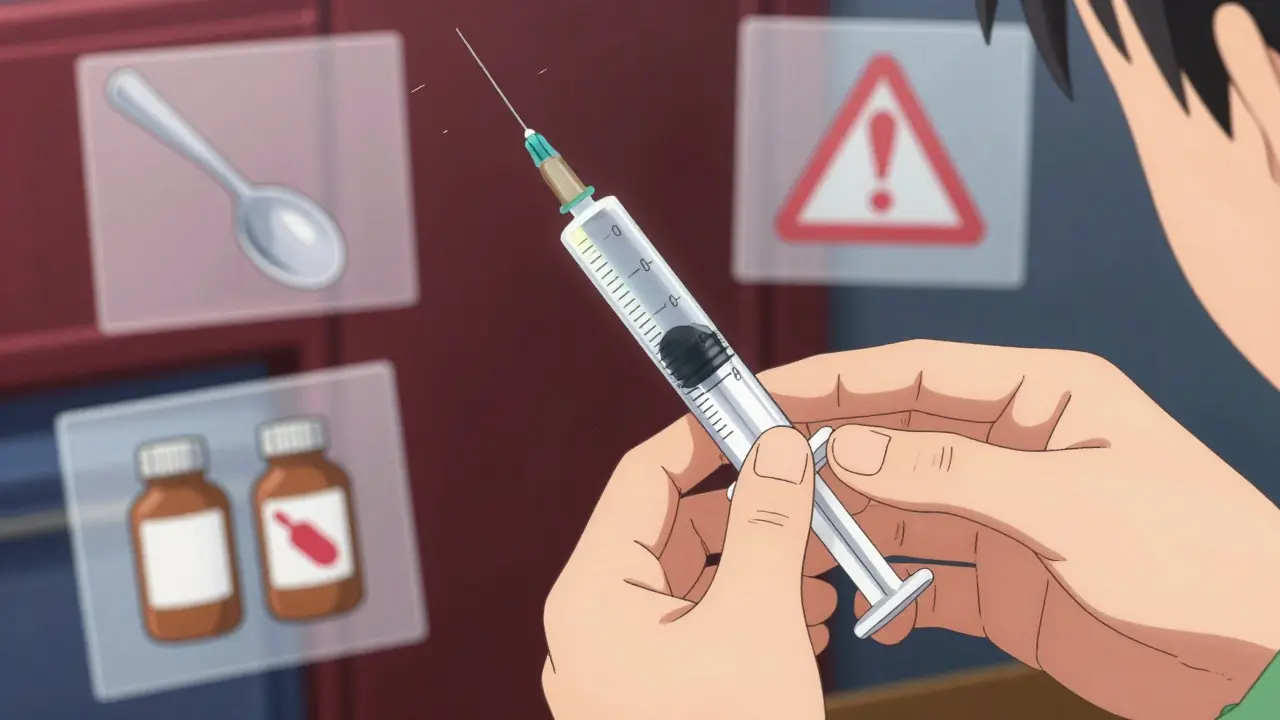
Never use a kitchen spoon. Not even the “measuring” one. A tablespoon from your drawer might hold 18 mL instead of 15. A teaspoon might be 4 mL, not 5. That’s a 20-30% error right there.
The only safe tools are:
- Oral syringe (with mL markings)
- Dosing cup that came with the medicine
- Plastic dosing spoon (if it has clear mL lines)
Hold the syringe at eye level. Look at the bottom of the curve in the liquid-the meniscus. If you look from above, you’ll think it’s at 5 mL when it’s really 4.5. Look from below, and you’ll think it’s 5 when it’s 5.5. That’s a 10% error. Tiny, but dangerous for kids.
Pro tip: If the dose is 2.3 mL, round up to 2.5 mL if you can’t measure finer. Never round down. Underdosing means the medicine won’t work. Overdosing is riskier, but underdosing leads to longer illness or complications.
Common Mistakes (And How to Avoid Them)
Here are the top 5 mistakes parents make-and how to stop them:
- Confusing infant drops with children’s liquid: Infant drops used to be 80 mg/0.8 mL. Now, they’re all 160 mg/5 mL. But some old bottles are still around. Always check the concentration. If it says “80 mg per 1.25 mL,” stop. That’s outdated. Use only the current standard: 160 mg/5 mL.
- Mixing up tsp and tbsp: One tablespoon = 3 teaspoons. Giving 1 tbsp when the label says 1 tsp is a 300% overdose. That’s enough to send a child to the ER. Always write it out: “1 tsp = 5 mL.”
- Using two medicines with the same active ingredient: Cold medicine + Tylenol = double acetaminophen. That’s the #1 cause of liver damage in kids. Always check the active ingredient. If both say “acetaminophen,” don’t mix them.
- Not knowing your child’s weight: If you haven’t weighed your child in the last 6 months, you’re guessing. Get a digital baby scale. They cost under $30. Or weigh yourself holding your child, then weigh yourself alone. Subtract. That’s their weight.
- Not checking the expiration date: Expired medicine doesn’t work. It can also break down into harmful chemicals. Always toss it after the date.
What to Do If You’re Not Sure
When in doubt, call someone. Don’t guess. Don’t search online. Don’t ask a friend.
- Call your pharmacist. They’re trained for this. Most will walk you through it over the phone. They’ve seen this a thousand times.
- Call your pediatrician’s office. Many have nurses on call for exactly this kind of question.
- Use the AAP’s Safe Dosage Calculator app. It’s free. You enter your child’s weight, pick the medicine, and it tells you the exact dose.
- Ask the pharmacist to mark the syringe for you. They’ll draw a line with a permanent marker at the exact dose your child needs. That way, you don’t have to measure every time.
One parent on Reddit said: “I called my pharmacist. She drew a line on the syringe for my 4-year-old’s exact dose. Now I don’t stress every time I give medicine.” That’s the kind of help you can get. Use it.

Special Rules for Babies Under 2
If your child is under 2 years old, don’t give any over-the-counter medicine without talking to a doctor first. Their liver and kidneys are still developing. They process medicine differently. A dose that’s safe for a 3-year-old could be toxic for a 1-year-old.
Even for something as simple as acetaminophen, pediatricians prefer to calculate the dose based on exact weight. Don’t use the age chart on the bottle. Go to the doctor. Bring your child’s weight. Ask for the exact mL amount. Write it down.
And never, ever give aspirin to a child under 18. It can cause Reye’s syndrome-a rare but deadly condition.
Tools and Resources to Keep You Safe
- Free apps: AAP’s Safe Dosage Calculator, CDC’s Medication Safety Checklist
- Free websites: HealthyChildren.org (from the American Academy of Pediatrics), FDA’s “Medicine: Play It Safe” toolkit
- Must-have tools: Oral syringe (0.1 mL increments for babies), digital baby scale, notepad to write down doses and times
- Pro tip: Take a photo of the label after you measure the dose. Keep it in your phone. Next time, you won’t have to re-read the whole thing.
The FDA says that if every parent read labels properly, over 68% of pediatric medication emergencies could be avoided. That’s tens of thousands of kids who don’t have to go to the hospital.
Can I use a kitchen spoon if I don’t have a syringe?
No. Kitchen spoons vary in size and are not accurate. A tablespoon can hold anywhere from 14 to 18 mL, while the correct dose is 15 mL. Even a 3 mL difference can be dangerous for a small child. Always use the oral syringe or dosing cup that came with the medicine.
What if my child’s weight isn’t listed on the label?
Use the closest weight range. If your child weighs 27 pounds and the chart lists 25-30 pounds, use the dose for that range. If your child is between two weight categories, round up to the higher dose only if they’re closer to the upper limit. When in doubt, call your pharmacist or pediatrician.
Is it safe to give children’s ibuprofen and acetaminophen together?
Yes, but only if you’re careful. You can alternate them every 3-4 hours if your child still has a fever. But never give both at the same time. Keep a log: 8 AM-acetaminophen, 11 AM-ibuprofen, 2 PM-acetaminophen. This helps you avoid giving too much of either.
How do I know if the medicine is expired?
Check the expiration date on the bottle or box. It’s usually printed as “EXP MM/YYYY.” If it’s past that date, throw it away-even if it looks fine. Liquid medicine can lose potency or grow bacteria. Never use expired medicine for a child.
What should I do if I think I gave my child too much medicine?
Call Poison Control immediately at 1-800-222-1222 (U.S.) or your local emergency number. Don’t wait for symptoms. Even if your child seems fine, too much acetaminophen can damage the liver without showing signs for hours. Keep the medicine bottle with you when you call-they’ll need the exact name and concentration.
Final Reminder: When in Doubt, Ask
You don’t have to be a doctor to give medicine safely. You just have to be careful. Know your child’s weight. Read the label twice. Measure exactly. Don’t guess. And if you’re unsure-call someone. A pharmacist, a nurse, your pediatrician. They’ve all been there. They won’t judge you. They’ll help you. Because getting it right isn’t just about following instructions. It’s about keeping your child safe.





Comments
man i used to just eyeball it till my cousin's kid got sick from too much tylenol... now i use the syringe and write it down. peace out 🤝
in india many parents use spoon because no syringe available. but now i teach them to use cap with mark. simple but save life.
Oh please. You think parents are dumb? No. The system is designed to confuse you. Why does the label say 'for ages 2-11' when it should say 'for 15-50 lbs'? Corporations want you to guess. They profit from ER visits. And now you're telling me to read the label? Like that's the problem? LOL.
this is so helpful 😊 i used to panic every time i had to give medicine... now i keep a little notepad in my diaper bag with doses written down. life saver!
I must point out, your entire framework is fundamentally flawed. You assume parents are rational actors with access to calibrated tools. In reality, most are sleep-deprived, under-educated, and economically disenfranchised. The onus shouldn't be on them to decode pharmaceutical hieroglyphics-it should be on the FDA to mandate plain-language, weight-only labeling. Also, your 'pro tip' about taking a photo? That's not a solution. It's a Band-Aid on a hemorrhage.
I’ve been a nurse for 15 years. Always measure. Always write it down. Always call if unsure. It’s not complicated. Just slow down.
Wow. A whole article about reading labels. I’m shocked. Who knew you weren’t supposed to use a soup spoon for kids’ medicine? Maybe next time we’ll get a guide on how to breathe.
i didnt know the difference between tsp and tbsp was so big... i always thought it was like 1 or 2 ml. my bad. gonna buy a syringe today. thanks for the heads up.
The fact that this information even needs to be disseminated is a national disgrace. We live in a society where parents are expected to become pharmacists overnight, while pharmaceutical companies prioritize profit margins over clarity. This is not an education issue-it is a systemic failure of regulatory oversight, corporate accountability, and public health infrastructure. And yet, here we are, blaming the parent.
I’m from the Philippines and we don’t always have access to oral syringes. But I learned to use a clean medicine cap with a line drawn in marker. It’s not perfect, but it’s better than guessing. Thank you for reminding us that we’re not alone in this. You’re helping more people than you know.
This is gold. I showed my sister-in-law in London and she cried because she’d been using a kitchen spoon for months. We need more of this. Not just info-compassion. Thanks for writing this.