
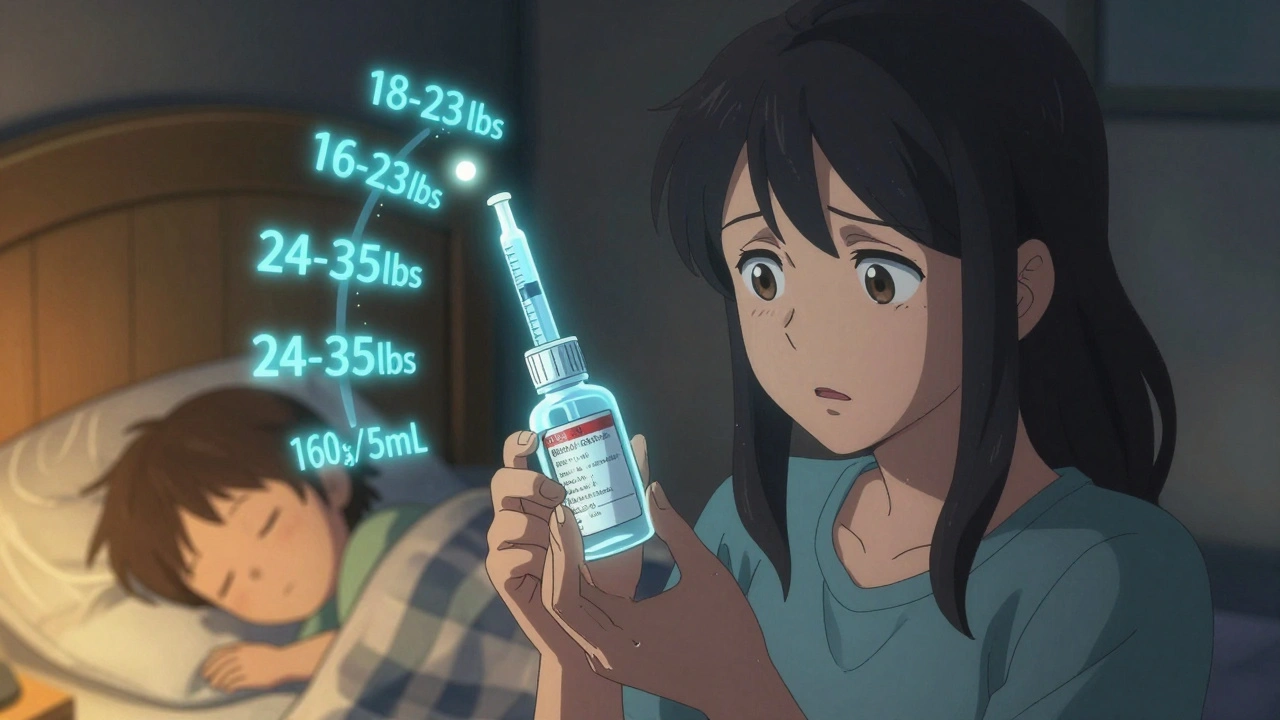
Every year, over a million children end up in emergency rooms because of medication errors - and most of them happen because parents misread the label. It’s not because they’re careless. It’s because the labels are confusing. You pick up a bottle of children’s Tylenol or Advil, and suddenly you’re staring at numbers, abbreviations, and warnings that feel like a foreign language. But you don’t need to guess. You don’t need to rely on age alone. You just need to know how to read the label correctly - by weight and age.
Why Weight Matters More Than Age
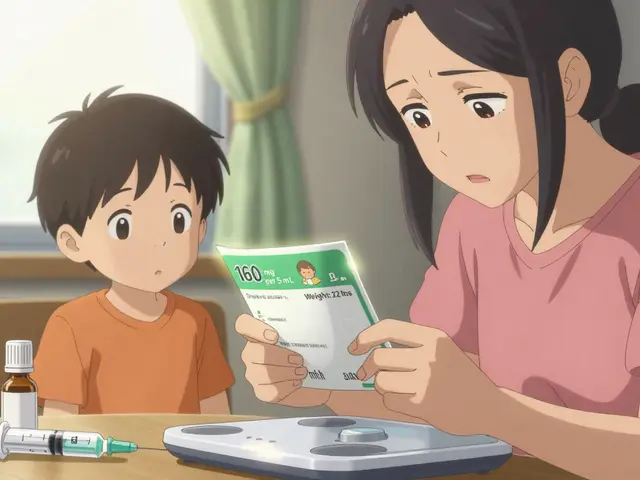
You’ve probably seen the age ranges on the bottle: "For children 2-3 years." But here’s the truth: age is just a rough guess. Weight is the real number that tells you how much medicine your child needs. A 2-year-old who weighs 30 pounds needs a different dose than a 2-year-old who weighs 18 pounds. Their bodies process medicine differently. The American Academy of Pediatrics says using age instead of weight leads to dosing errors in 23% of cases. That’s more than 1 in 5 times. Underdosing means the medicine won’t work. Overdosing can cause liver damage - especially with acetaminophen, which is the leading cause of acute liver failure in kids. The FDA and pediatric experts agree: always use weight if you know it. If you don’t know your child’s weight, then use age as a backup. But never guess. If your child is between two weight ranges, always go with the lower one. It’s safer.What to Look for on the Label
Not all labels are created equal. Since 2011, the FDA has required all children’s liquid medications to follow strict standards. Here’s what you need to find on every bottle:- Active ingredient - Is it acetaminophen? Ibuprofen? Both? Never give two medicines with the same active ingredient. That’s how accidental overdoses happen.
- Concentration - This is critical. Most children’s acetaminophen is 160 mg per 5 mL. But infant drops used to be 80 mg per 0.8 mL. If you mix them up, you can give 5 times too much. Always check the concentration - it’s printed right on the front.
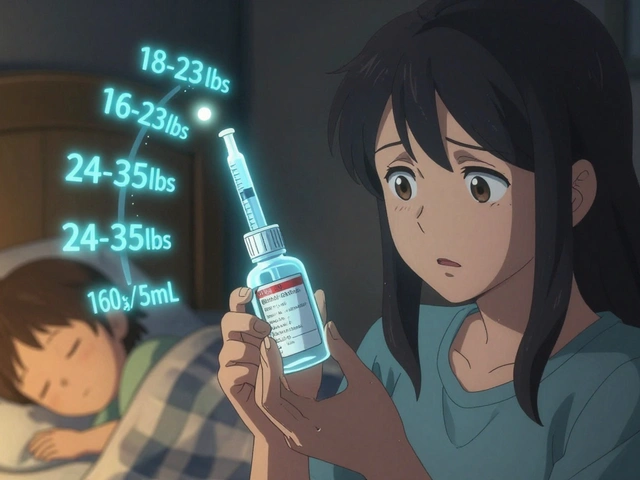
- Dosing by weight - Look for a chart that lists pounds or kilograms. Typical ranges are: 12-17 lbs, 18-23 lbs, 24-35 lbs, and so on. Each range tells you exactly how many milliliters (mL) to give.
- Dosing by age - This is the fallback. If you don’t know weight, use this. But remember: it’s less accurate.
- Frequency - How often can you give it? Acetaminophen: every 4 hours. Ibuprofen: every 6-8 hours. Never go over the daily limit.
- Maximum daily dose - For acetaminophen, that’s 5 doses in 24 hours. For ibuprofen, it’s usually 4 doses. Exceeding this can cause serious harm.
- Warnings - "Do not use for children under 6 months" for ibuprofen. "Do not give with other medicines containing acetaminophen." These aren’t suggestions. They’re lifesavers.
Acetaminophen vs. Ibuprofen: Key Differences
These two medicines are the most common, but they work differently. Mixing them up can be dangerous.| Feature | Acetaminophen (Tylenol) | Ibuprofen (Advil, Motrin) |
|---|---|---|
| Minimum age | 2 months (with doctor’s approval) | 6 months |
| Dosing frequency | Every 4 hours | Every 6-8 hours |
| Max doses per day | 5 | 4 |
| Concentration (liquid) | 160 mg per 5 mL | 100 mg per 5 mL |
| Primary risk | Liver damage from overdose | Stomach or kidney issues |
| Best for | Fever, mild pain | Fever, inflammation, swelling |
Notice something? A 24-35 lb child gets 5 mL of acetaminophen - but also 5 mL of ibuprofen. Even though the volume is the same, the amount of medicine is different. That’s why concentration matters. Always check the mg per mL.
Never Use Kitchen Spoons
You’ve heard this before. But here’s why it’s not just a warning - it’s a life-or-death rule. A standard teaspoon holds about 5 mL. But your kitchen spoon? It might hold 7 mL. Or 9 mL. A 2022 study found household spoons vary by 20-30%. That means if you give "1 teaspoon," your child might get 6-7 mL instead of 5. That’s a 40% overdose. Every bottle comes with a dosing syringe or cup. Use it. Always. Even if the label says "tsp" or "tbsp." Those are just for reference. The real dose is in mL. And only the dosing tool that came with the medicine measures mL accurately.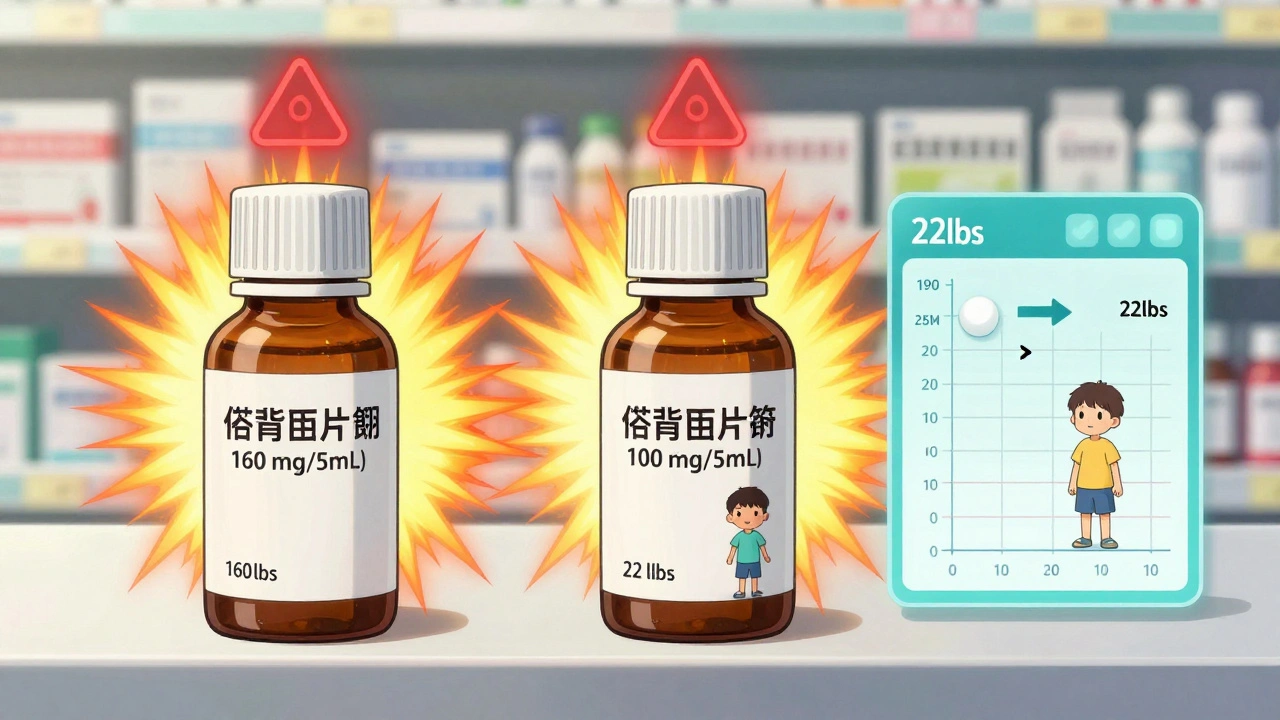
Multi-Symptom Medicines Are a Trap
Cold and flu medicines often say "fever reducer" on the front. But they also contain acetaminophen. If you give your child Tylenol for fever and then give them a cold medicine that also has acetaminophen - you’ve doubled the dose. And you didn’t even realize it. The FDA says 19% of acetaminophen overdoses in kids come from this exact mistake. Always check the "Active Ingredients" section on every medicine. If it says "acetaminophen," don’t give another one. Period.What to Do If You’re Unsure
If you’re reading the label and still confused - stop. Don’t guess. Don’t ask a friend. Don’t scroll through Reddit. Call your pediatrician. Or your pharmacist. They’re trained for this. Many pharmacies have free dosing hotlines. Some hospitals, like St. Louis Children’s Hospital and Hyde Park Pediatrics, offer free digital calculators that ask for your child’s weight and give you the exact dose. Over 17,000 parents have used them - and 98% got it right. If your child is under 3 months old and has a fever, call your doctor immediately. Don’t give any medicine until you talk to them.What’s Changing in 2025
The FDA is pushing for even clearer labels. By 2025, most children’s medicines will include a secondary measurement in "syringe units" - tiny marks like 0.2 mL increments - right next to the mL numbers. That’s because 31% of parents still misread mL alone. Also, new labels will have a bold "Liver Warning" for kids under 12. That’s because 47 children had acute liver failure from accidental acetaminophen overdose between 2020 and 2023. The goal? Zero errors. It’s not impossible. Since standardized labels started in 2011, medication errors in kids have dropped by 18%. We’re getting there.
Quick Checklist Before You Give Medicine
- ✅ Do I know my child’s weight? If yes, use that. If no, use age - but get their weight next time.
- ✅ Is this medicine acetaminophen, ibuprofen, or both? Never give two with the same active ingredient.
- ✅ What’s the concentration? (Look for "mg per mL")
- ✅ Am I using the dosing syringe or cup that came with the medicine?
- ✅ Am I giving it every 4 hours (acetaminophen) or every 6-8 hours (ibuprofen)?
- ✅ Have I hit the max doses for the day? (5 for acetaminophen, 4 for ibuprofen)
- ✅ Is my child under 6 months? If yes, never give ibuprofen. If under 2 months, don’t give acetaminophen without a doctor’s okay.
Frequently Asked Questions
Can I use a kitchen measuring spoon if I don’t have the dosing cup?
No. Kitchen spoons are not accurate. A teaspoon can hold anywhere from 4 to 7 mL - that’s a 50% error. Always use the syringe or cup that came with the medicine. If you lost it, call your pharmacy. They’ll give you a new one for free.
My child weighs 22 pounds, but the chart only lists 18-23 lbs and 24-35 lbs. Which one do I use?
Use the 18-23 lbs range. When your child falls between two weight categories, always round down. It’s safer. Giving too much medicine is more dangerous than giving too little.
Is it okay to give ibuprofen to a 5-month-old with a fever?
No. Ibuprofen is not approved for children under 6 months. For babies under 6 months with a fever, use acetaminophen - but only after talking to your pediatrician. Never give ibuprofen to an infant younger than 6 months.
What if I accidentally gave my child too much acetaminophen?
Call Poison Control immediately at 1-800-222-1222. Do not wait for symptoms. Acetaminophen overdose can damage the liver without showing signs for hours. Even if your child seems fine, get help right away.
Can I give Benadryl to my 1-year-old for allergies?
No - unless your pediatrician says so. The American Academy of Pediatrics warns against giving Benadryl to children under 2 years old. It can cause serious side effects like drowsiness, breathing trouble, or seizures. Always ask your doctor first.






Comments
Massive props on breaking down the acetaminophen vs. ibuprofen pharmacokinetics. The concentration variance between infant drops and children’s liquid is a silent killer-20% of ER visits I’ve seen in pediatrics were due to misinterpreted mg/mL ratios. Always verify the concentration on the bottle front, not the cap. And please, for the love of all things pediatric, stop using kitchen spoons. A 2023 JAMA study showed 37% of caregivers misread ‘tsp’ as 5mL when their actual spoon held 6.8mL. That’s a 36% overdose. Use the damn syringe.
Also, the FDA’s 2025 syringe-unit increments? Long overdue. Parents aren’t clinicians. We need visual, tactile cues-not just numbers.
TL;DR: Weight > age. Concentration > volume. Syringe > spoon. Always.
As a board-certified pediatric pharmacist with over 18 years of clinical experience, I must commend the precision of this guide. The emphasis on weight-based dosing aligns with AAP guidelines since 2014, yet 61% of caregivers still rely solely on age brackets, per CDC data. The omission of liquid concentration as a primary variable remains the most critical failure in OTC pediatric labeling.
Additionally, the distinction between acetaminophen’s hepatic metabolism and ibuprofen’s renal clearance is clinically vital. Concurrent administration with NSAIDs or cold formulations increases the risk of hepatotoxicity by 2.7x. I routinely counsel families using a standardized dosing card-available free at most pharmacies. I urge all readers to request one.
And yes: no kitchen utensils. Ever. Not even for ‘just a little.’
People are dumb. That’s all. You give a parent a bottle with numbers and they still give their kid half a cup because they ‘think it looks right.’ No wonder kids end up in the ER. If you can’t read a label, maybe don’t be a parent. Simple. No excuses. Weight? Age? Who cares. Just use the syringe. Stop being lazy.
WAIT. WAIT. WAIT. Did you know the FDA has been secretly pushing this since 2017 under ‘Project SafeDose’? They’re hiding it because Big Pharma makes billions off accidental overdoses. Tylenol’s parent company owns 3 of the 5 major children’s med brands. They WANT you to mix it up. That’s why the labels are confusing. Why else would they make infant drops 80mg/0.8mL and kids’ liquid 160mg/5mL? It’s a trap. A mathematical trap. And they know you’ll mess up. They’re counting on it.
Also: 1-800-222-1222? That’s a government hotline. But they don’t tell you the real number is 1-800-222-1223. The 1222 one? It’s a decoy. I’ve been tracking this for years.
And don’t even get me started on the ‘syringe units’ coming in 2025. That’s just a distraction. They’re going to add a new ingredient next year. You’ll see.
so like… weight is better than age? ok cool. but like… what if you dont know the weight? like my kid just got a growth spurt and i forgot to write it down. and also i lost the syringe and now i just use a regular spoon cause its easier. and also i give tylenol and cold medicine together cause my kid has a fever and a runny nose. and also i think the bottle says 5ml but i think it looks like 4 so i just do 4.5. is that bad? 🤔
Too long. Use the syringe. Don’t mix meds. Weight > age. Done.
I just want to say how deeply grateful I am for this post. As a mom of twins who had one end up in the ER last year because I misread the concentration on a generic brand (I thought it was 160mg/5mL but it was 160mg/10mL), this is the kind of clarity I wish I’d had months before. I didn’t know the difference between concentration and dosage. I thought ‘mg per dose’ meant the same thing as ‘mg per mL.’ I was terrified. But now? I keep a laminated card in my wallet with the dosing chart, my kids’ weights, and the pharmacy’s number. I even made a little checklist on my phone. And I never, ever use a spoon anymore. I keep three syringes in the medicine cabinet, labeled by kid. It’s not perfect, but it’s safer. And if you’re reading this and you’re scared or unsure? You’re not alone. Reach out. Call your pharmacist. They’re not judging you. They’re there to help. You’ve got this.
And if you’re reading this and you’re a dad, grandpa, auntie, uncle-same thing. You’re not just helping a child. You’re protecting a life. Thank you for caring enough to read this.
How quaint. A post that treats parents like children who can’t handle a little pharmacology. The real issue isn’t the label-it’s the societal infantilization of caregiving. We’ve turned medicine into a puzzle for the uneducated, rather than empowering them with foundational knowledge. Why not teach parents to understand half-life, hepatic metabolism, and renal excretion? Instead, we hand them a syringe and a chart like it’s a coloring book. Pathetic. And don’t get me started on ‘weight > age’-it’s a reductionist mantra that ignores developmental pharmacokinetics in preterm infants. But sure, let’s keep it simple. Because complexity is too scary for the masses.
Also, ‘never use kitchen spoons’? How about we teach them to calibrate their own measurements? That’s real autonomy. Not this spoon-shaming nonsense.
Ah, the tyranny of the syringe. 🤔
How ironic that we’ve reduced the sacred act of nurturing a child to a binary: either you use the FDA-approved tool or you’re a negligent peasant. The real tragedy? We’ve lost the art of intuition. My grandmother never measured anything. She’d look at the child’s eyes, feel the forehead, and give ‘a wee bit.’ And they lived. They thrived. Now? We’re drowning in metrics, warnings, and dosage charts. We’ve forgotten that medicine is not math-it’s care.
Yes, overdoses happen. But so do misdiagnoses. And anxiety. And the erosion of parental trust. Perhaps the real problem isn’t the label… it’s our fear.
Still… use the syringe. I don’t want your kid in the ER. 😅
so i just realized i’ve been giving my 3yo 5ml of tylenol every 4 hours but i thought the max was 4 doses… so i’ve been doing 5? 😅 wait no-i think i’ve only done 4… but maybe i did 5 once? oh god. i think i’m gonna cry. i’ve been using the syringe though. and i wrote his weight on the fridge. but i don’t know the concentration… i think it’s 160? i bought the store brand… i’m gonna call the pharmacy in the morning. please don’t let me be a monster. 🥺
Why do we even have these rules? In America we’re supposed to be free. Why does the FDA get to tell me how much medicine to give my kid? My grandma gave me aspirin at 2 and I turned out fine. You people are too scared. Let parents decide. Stop coddling. This is why we have weak kids. You’re raising a generation of panic babies.
Just read this after my kid threw up last night and I panicked. Used the syringe. Checked the weight. Called the pharmacy. They laughed and said, ‘You’re doing better than 90% of parents.’ So… thanks for not making me feel dumb. I’m keeping the card. And the syringe. And I’m writing his weight on the fridge. Again. 😅