
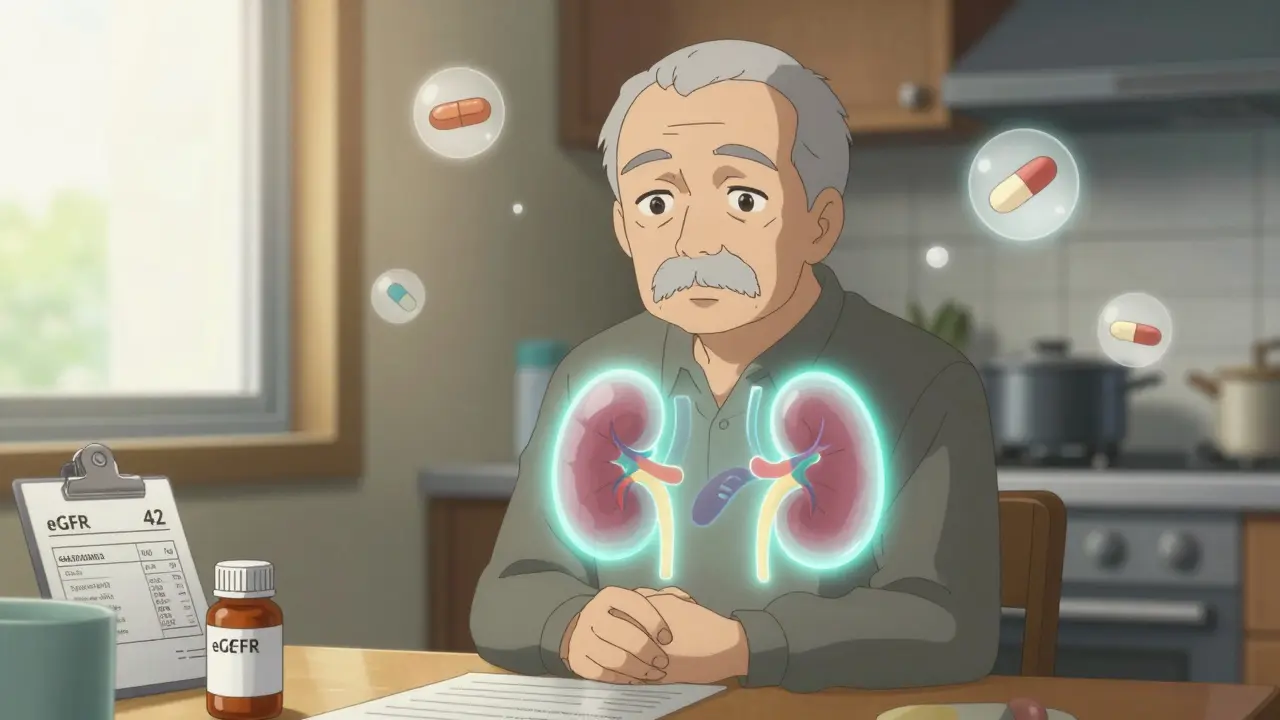
When you’re older, your body doesn’t process medicine the same way it did when you were younger. That’s not just a guess-it’s science. A 75-year-old taking the same pill as a 45-year-old might be getting too much, too little, or even the wrong kind of effect. Medication dosage adjustments for aging bodies and organs aren’t optional. They’re essential. And yet, most people don’t know this until they’re already in the hospital because of a bad reaction.
Why Aging Changes How Drugs Work
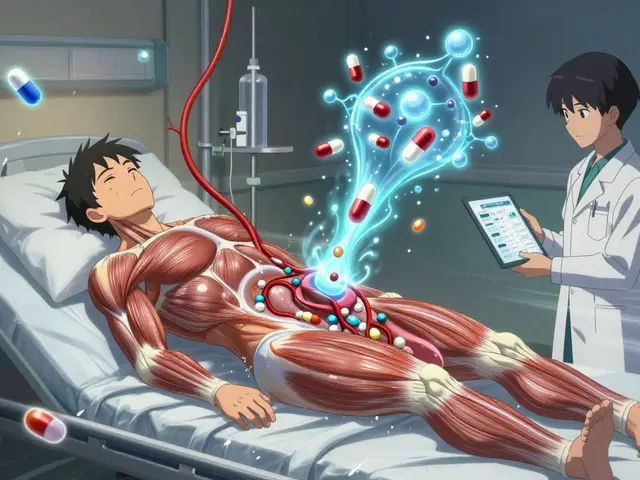
Your body changes as you age. Your stomach makes less acid. Your liver slows down. Your kidneys filter less. Your body holds onto more fat and loses muscle. These aren’t minor quirks-they change how drugs are absorbed, distributed, broken down, and flushed out of your system.For example, if you’re over 65, your kidneys may be filtering 30-50% less than they did at 30. That means drugs like gabapentin, metformin, or certain antibiotics stick around longer in your bloodstream. The result? Higher risk of dizziness, confusion, falls, or even kidney damage. Studies show that 40% of adults over 65 have kidney function low enough to require a lower dose of at least one medication they’re taking.
And it’s not just kidneys. The liver, which breaks down most pills, also loses efficiency. By age 70, many people process drugs 30-50% slower. That’s why a standard dose of a sleeping pill or painkiller can leave an older adult groggy all day-or worse, cause a dangerous drop in blood pressure.
The ‘Start Low, Go Slow’ Rule
Doctors have known for decades that older adults need different dosing. The rule? Start low, go slow. That means beginning with a fraction of the usual dose and waiting weeks before increasing it. It’s the opposite of how younger adults are treated.Take metformin, a common diabetes drug. For a 50-year-old, the starting dose might be 500mg twice daily. For a 75-year-old? It’s often 250mg once a day, with a careful check of kidney function before even starting. If kidney function drops below 30 mL/min, the drug is stopped entirely. Why? Because it builds up and can cause a rare but deadly condition called lactic acidosis.
Same with gabapentin. A standard starting dose is 300mg at night. For someone over 70? Often 100mg at night. Why? Because their kidneys can’t clear it fast enough. Too much leads to dizziness, falls, and broken hips-exactly what we’re trying to avoid.
What Happens When Doses Aren’t Adjusted
Unadjusted doses aren’t just ineffective-they’re dangerous. A 2022 study in JAMA Internal Medicine found that 35% of hospital admissions in people over 65 were caused by medication problems. Most of these were avoidable. They happened because someone was given the same dose they got at 50, even though their body had changed.Some of the most common offenders:
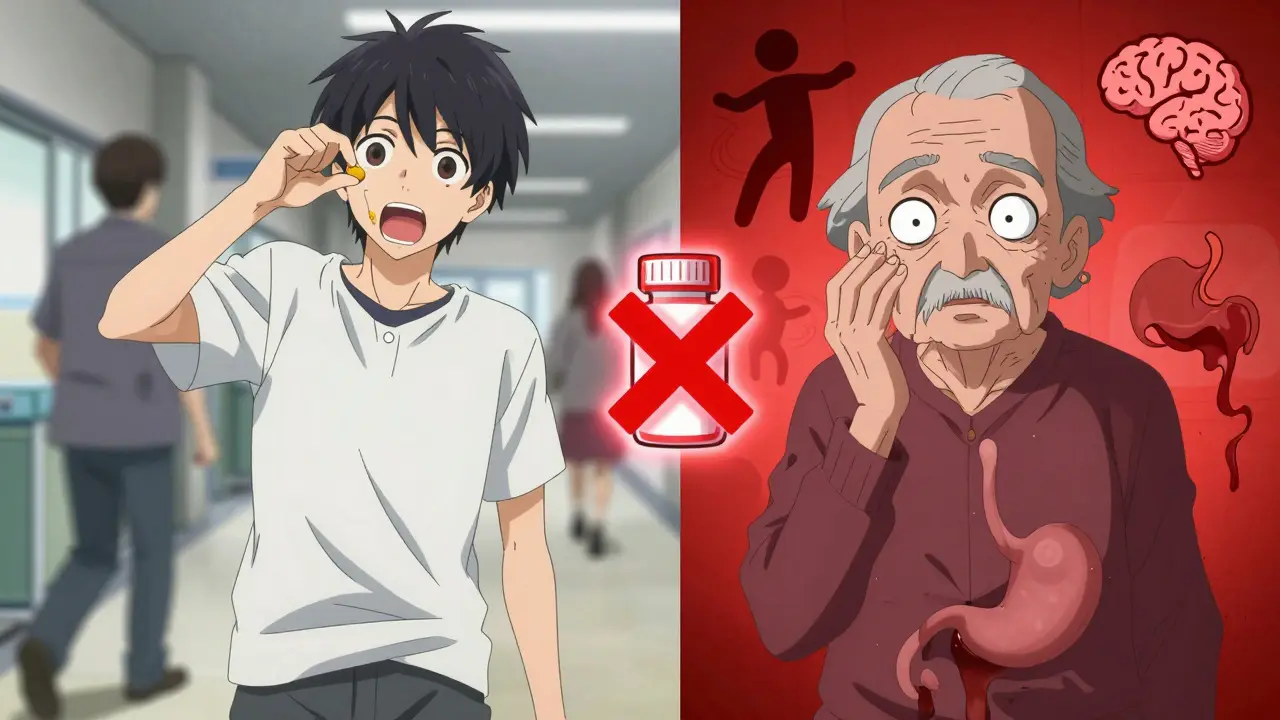
- Benzodiazepines (like lorazepam or diazepam): Increase fall risk by 50%. Even low doses can cause confusion or memory loss.
- NSAIDs (like ibuprofen or naproxen): Raise risk of stomach bleeding by 300%. Kidneys can’t handle the strain.
- Anticholinergics (used for overactive bladder, allergies, or sleep): Double the risk of dementia with long-term use.
- Warfarin: Requires 20-30% lower doses in older adults. Too much? Life-threatening bleeding. Too little? Blood clots.
These aren’t rare cases. In nursing homes, 27% of adverse drug events come from incorrect dosing. And it’s not just doctors making mistakes. Many patients don’t know to ask. They take what’s in the bottle, assume it’s right, and never mention their other pills.
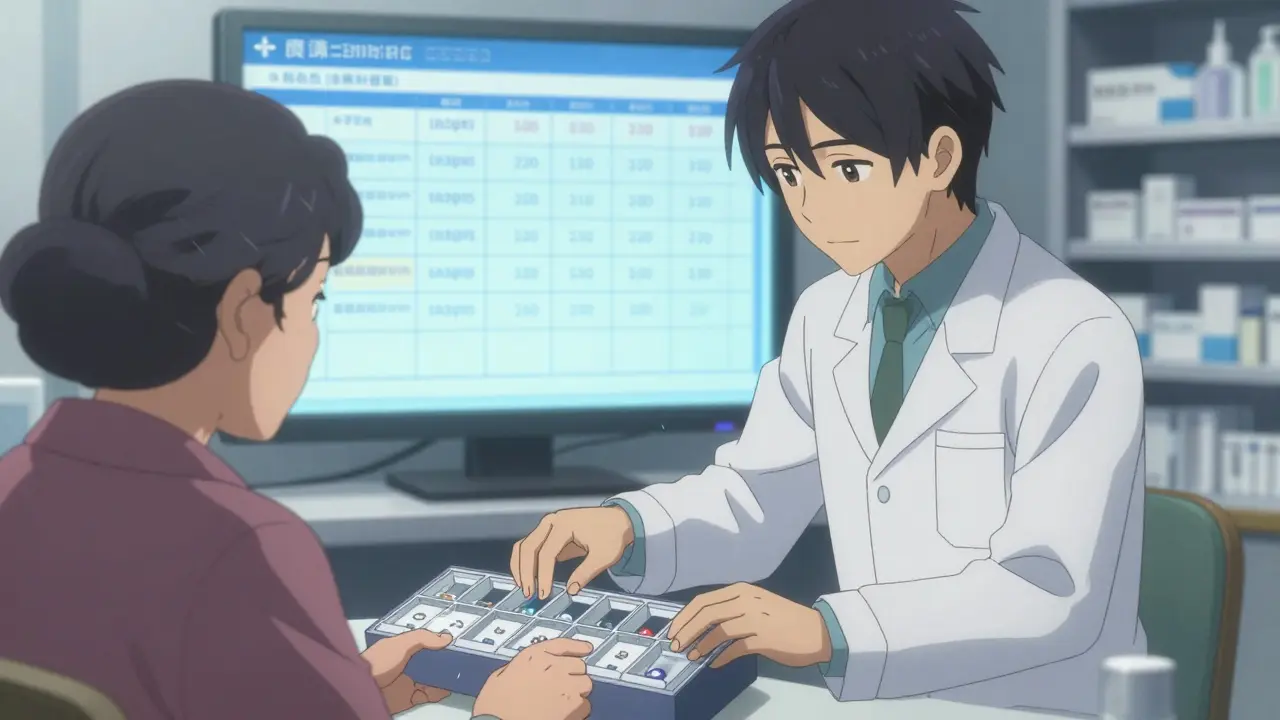
How Doctors Adjust Doses-The Real Math
Adjusting a dose isn’t guesswork. It’s based on measurable changes in the body. The most common tool? The Cockcroft-Gault equation. It estimates kidney function using age, weight, and a simple blood test (serum creatinine).Here’s the formula for men: CrCl = [(140 − age) × weight(kg)] / [72 × serum creatinine]
For women, multiply that result by 0.85.
If your CrCl is below 50 mL/min, most kidney-cleared drugs need a 25-50% reduction. If it’s below 30? Often, the drug is stopped. No exceptions.
For drugs processed by the liver, doctors use the Child-Pugh score. It looks at things like jaundice, fluid buildup, and mental confusion. A score of 7-9? Cut the dose in half. A score of 10-15? Don’t use the drug at all.
And here’s something most people don’t realize: some drugs should never be used in older adults. The American Geriatrics Society’s Beers Criteria® (updated in 2023) lists 30 classes of drugs that are too risky. That includes antihistamines like diphenhydramine (Benadryl), certain muscle relaxants, and even some antidepressants. These aren’t “bad drugs.” They’re just dangerous for aging bodies.
What You Can Do-Practical Steps
You don’t need to be a doctor to protect yourself. Here’s what actually works:- Do a brown bag review. Every six months, take every pill, supplement, and OTC medicine you take to your doctor or pharmacist. Don’t leave anything out. Not even the herbal tea or the aspirin you take for headaches.
- Ask: “Is this dose right for me?” Don’t assume. Say: “I’m 72. My kidneys aren’t what they used to be. Should this dose be lower?”
- Know your kidney number. Ask for your eGFR (estimated glomerular filtration rate). If it’s below 60, talk to your doctor about all your meds.
- Use pill organizers. Blister packs with weekly doses reduce errors by 40%. Pharmacists can set them up for you.
- Involve a family member. Studies show that when a caregiver helps manage meds, adherence improves by 37% and errors drop by half.
Many pharmacies now offer free medication reviews. Use them. They’re not just for people in nursing homes. If you’re over 65 and on three or more prescriptions, you’re at risk.
Why This Is So Hard to Get Right
The system isn’t designed for this. Most clinical trials exclude people over 75. That means the dosing guidelines for 70% of drugs prescribed to seniors are based on data from younger, healthier people. The FDA only started requiring age-specific data in 2017. Even now, 40% of seniors are still left out of research.Doctors get minimal training in geriatric pharmacology. A 2021 survey found that 65% of U.S. physicians feel unprepared to adjust doses for older patients. And a typical doctor visit lasts 15-20 minutes. A full medication review? Takes 35 minutes.
That’s why pharmacist-led programs are so effective. At the University of North Carolina, a program called Pharm400 used weekly blister packs and regular check-ins. The result? Hospital visits dropped by 22%. Costs fell. Safety improved. And it wasn’t expensive.
The Future: Personalized Dosing
The future of medication for older adults isn’t just about age. It’s about function. A 70-year-old who walks fast, thinks clearly, and has strong kidneys might need a standard dose. A 70-year-old who uses a cane, gets confused easily, and has weak kidneys? Needs much less.New tools are emerging. AI algorithms now analyze lab results, mobility tests, and cognitive scores to suggest dosing. One pilot at Johns Hopkins cut dosing errors by 47%. And the NIH is investing $127 million to build models that predict how drugs behave in aging bodies-not just based on numbers, but on real-life function.
By 2030, experts predict that 70% of high-risk medications will be dosed based on individual metabolism, not just age. That’s a big shift. But it’s necessary. Because aging isn’t a number. It’s a process. And your body’s ability to handle medicine changes every year.
Why can’t I just take the same dose I’ve always taken?
Your body changes as you age. Your kidneys and liver slow down, your body fat increases, and your muscle mass decreases. These changes mean drugs stay in your system longer and can build up to dangerous levels. A dose that was safe at 50 might be too strong at 75. Taking the same dose without adjustment increases your risk of falls, confusion, kidney damage, or hospitalization.
What’s the most common mistake doctors make with older patients’ meds?
The biggest mistake is assuming a standard adult dose is safe for older adults. Many prescriptions are written without checking kidney or liver function. For example, gabapentin, metformin, or warfarin are often prescribed at full doses even when the patient’s creatinine clearance is below 50 mL/min. This leads to overdosing, which causes dizziness, low blood pressure, or even internal bleeding.
Should I stop taking a medication if my doctor doesn’t mention a dose change?
No, don’t stop without talking to your doctor. But do ask: “Is this dose appropriate for my age and kidney function?” If your doctor can’t answer, ask for a pharmacist consult. Many pharmacies offer free medication reviews. You have the right to ask for a second opinion.
How do I know if my kidneys are affected?
Ask for your eGFR (estimated glomerular filtration rate) from a recent blood test. If it’s below 60 mL/min/1.73m², your kidneys are working below normal. If it’s below 30, many common drugs need to be stopped or drastically reduced. This number is more important than your age when it comes to dosing.
Are over-the-counter meds safe for seniors?
Not always. Many OTC drugs are just as risky as prescriptions. Antihistamines like diphenhydramine (Benadryl), NSAIDs like ibuprofen, and sleep aids like melatonin can cause confusion, falls, or kidney damage in older adults. Always check with your pharmacist before taking anything new-even if it’s sold without a prescription.




Write a comment