

Breastfeeding Medication Timing Calculator
Medication Selection
Results & Recommendations
Select a medication to see recommendations
When you’re breastfeeding and need to take medication, the last thing you want is to worry about harming your baby. It’s a real concern - but here’s the good news: medication timing can cut your baby’s exposure to drugs by up to 75%. You don’t have to stop breastfeeding. You just need to know when to take your pills.
How Drugs Get Into Breast Milk
Medications don’t magically appear in breast milk. They move from your bloodstream into your milk based on how your body processes them. The key factor? Peak concentration. That’s when the drug hits its highest level in your blood - usually within an hour or two after you take it. That’s also when the most drug flows into your milk. Think of it like pouring water from a cup. If you pour right after filling it, the cup is full. If you wait an hour, some has spilled out. The same idea applies to drugs. Waiting until the drug level drops in your blood means less gets into your milk. The safety of a drug for your baby is measured by something called the Relative Infant Dose (RID). This is the percentage of your dose that your baby actually gets through milk. Experts agree: if the RID is under 10%, the risk is very low. For some drugs like ibuprofen or acetaminophen, the RID is less than 1%. For others, like morphine, it can be as high as 35%. That’s why timing matters - especially for higher-risk meds.Timing Strategies That Actually Work
The most effective timing rule is simple: breastfeed right before you take your medication. This gives your body time to break down the drug before the next feeding. For most short-acting drugs, waiting 2 to 3 hours after taking the pill before nursing again reduces infant exposure dramatically. Here’s how it works for common meds:- Acetaminophen (Tylenol): Safe anytime. Peak in 30-60 minutes. Half-life: 2-4 hours. No need to delay feeding.
- Ibuprofen (Advil): Also safe. Peak in 1-2 hours. Half-life: 2 hours. Lowest transfer to milk of all NSAIDs.
- Morphine: Peak at 0.5-1 hour. Half-life: 2-4 hours. Breastfeed first, then wait 2-3 hours before next feed.
- Oxycodone: Peak at 0.5-2 hours. Half-life: 3-4 hours. Avoid if possible - FDA warns of infant drowsiness and breathing problems.
- Codeine and Tramadol: Avoid entirely. FDA black box warnings. Some moms metabolize these too fast, flooding milk with dangerous levels. Timing won’t fix this.
- Diazepam (Valium): Peak at 0.3-2.5 hours, but half-life is 44-48 hours. Timing doesn’t help much. Use only if absolutely necessary.
- Alprazolam (Xanax): Peak at 1-2 hours. Half-life: 11 hours. Shorter than diazepam. Can be timed if used sparingly.
For psychiatric meds like SSRIs, use immediate-release versions if available. Extended-release pills keep drug levels steady all day, making timing useless. Immediate-release lets you control when the peak hits.
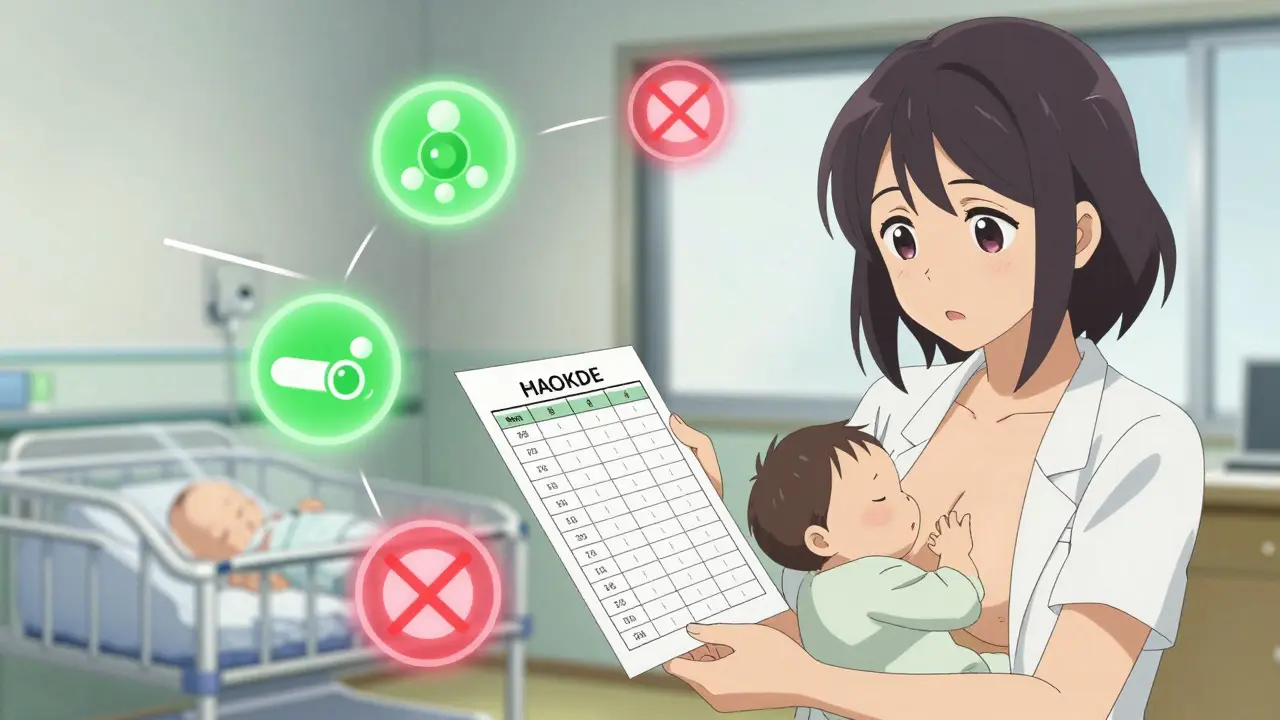
What to Avoid - Even With Timing
Some drugs are just too risky. No timing trick makes them safe.- Codeine: The FDA banned its use in breastfeeding mothers in 2017. Why? Some women are “ultra-rapid metabolizers.” Their bodies turn codeine into morphine way too fast. That means your baby gets a morphine overdose - even if you time it perfectly.
- Tramadol: Same problem. FDA warning in 2018. Can cause severe breathing issues in infants. Avoid completely.
- Heroin, cocaine, methamphetamine: These are never safe. No timing strategy works. Stop breastfeeding if you’re using these.
- Chemo drugs and radioactive isotopes: These require complete cessation of breastfeeding. Timing won’t help.
If you’re on any of these, talk to your doctor. There are safer alternatives. For example, buprenorphine is now preferred over methadone for mothers with opioid use disorder - and timing it right after breastfeeding reduces infant exposure to safe levels.
Special Cases: Newborns and Long-Term Meds
In the first 3 to 4 days after birth, your milk supply is small. Even if a drug transfers into milk, your baby gets almost nothing. Timing isn’t as critical then. But once your milk supply ramps up - usually by day 5 - timing becomes essential. Newborns feed every 2-3 hours. That makes scheduling tricky. Plan ahead. If you know you’ll need pain meds after a C-section, pump and store milk before surgery. That way, you can feed your baby without taking meds right after birth. For long-term meds - like antidepressants or blood pressure pills - timing helps, but it’s not always practical. If the drug has a long half-life (like sertraline or lamotrigine), it builds up slowly in your system. In these cases, the total daily dose matters more than the exact timing. Still, taking the pill right after a feeding helps keep overnight levels lower.
Real-Life Tips for Making It Work
You don’t need to be a pharmacist to get this right. Here’s what works in real life:- Keep a log. Write down when you take your meds and when you nurse. After a few days, you’ll see patterns.
- Use alarms. Set your phone to remind you when to take your pill and when to nurse next. It takes the guesswork out.
- Pump and dump? Only if needed. If you’re on a short-acting drug and miss your window, pumping won’t speed up clearance. It just removes milk you could’ve fed later. Save pumping for when you’re away from your baby or on long-acting meds.
- Ask your pharmacist. They have access to LactMed - the go-to database for breastfeeding and meds. Ask: “What’s the best time to take this while nursing?”
- Tell every provider you’re breastfeeding. Your dentist, GP, OB-GYN, even your physical therapist. Many don’t ask - so you have to speak up.
Most mothers find a rhythm within 1-2 weeks. It’s not perfect, but it’s manageable. And it lets you keep doing what matters most: feeding your baby.
Why This Matters - And Why It’s Underused
In the U.S., 92% of obstetricians and 85% of pediatricians know about medication timing. But only 35% of general doctors actually talk to moms about it. That’s a gap. Many women are told to stop breastfeeding - not because the meds are unsafe, but because no one told them how to time them. The CDC now lists medication timing as a key part of breastfeeding support. Twenty-seven states include it in Medicaid-covered lactation services. The Academy of Breastfeeding Medicine has had formal guidelines since 2018 - updated in 2022. This isn’t new science. It’s standard care. The bottom line? You don’t have to choose between being a healthy mom and being a nursing mom. With the right timing, you can be both.Can I take ibuprofen while breastfeeding?
Yes, ibuprofen is one of the safest pain relievers for breastfeeding mothers. Less than 1% of your dose transfers into milk, and it’s unlikely to affect your baby. You can take it anytime - even right after feeding. No need to time it.
Is it safe to take Tylenol while breastfeeding?
Absolutely. Acetaminophen (Tylenol) transfers in tiny amounts - under 0.5% of your dose - and has no known side effects in breastfed babies. You can take it as directed without changing your feeding schedule.
What should I do if I accidentally took a bad medication while breastfeeding?
Don’t panic. If you took codeine, tramadol, or a drug with a black box warning, skip the next feeding and pump and discard. Call your doctor or a lactation consultant immediately. For most other meds, even if you didn’t time it right, the risk is usually low. Use the LactMed database or call a poison control center for breastfeeding concerns - they’re trained to help.
Can I use pain meds after a C-section and still breastfeed?
Yes. Many hospitals now use a mix of acetaminophen and ibuprofen for post-C-section pain - both are safe. If you need an opioid, morphine or hydrocodone are preferred over oxycodone. Take your first dose right after your baby feeds, then wait 2-3 hours before the next feed. Pump and store milk before surgery if possible.
How do I know if my baby is reacting to my medication?
Watch for unusual sleepiness, difficulty feeding, irritability, or breathing problems. If your baby seems unusually drowsy or isn’t feeding well after you start a new med, contact your pediatrician. Most babies show no signs at all - especially with low-risk drugs. But if you’re unsure, it’s always better to check.







Comments
Take meds after feed thats it no need for all this overthinking
Look I’ve read every single study on this and I’ve talked to 17 pharmacists and 3 whistleblowers from the FDA and let me tell you something nobody wants you to know - the pharmaceutical companies are pumping these drugs into breast milk on purpose because they’ve got a secret deal with the CDC to make moms feel guilty enough to stop breastfeeding so they can sell more formula. I’m not kidding. The half-life numbers? Fabricated. The RID percentages? Cooked. They don’t want you to know that ibuprofen actually accumulates in fat cells and gets slowly released over 72 hours like a slow-release poison disguised as pain relief. And don’t even get me started on how the ‘pump and dump’ advice is just a scam to sell you extra bottles and pumps. I’ve got screenshots of internal emails. I’ve got diagrams. I’ve got a spreadsheet with 427 data points. You think your baby’s fine? You’re being manipulated. They’ve been doing this since the 80s. The real solution? Stop taking meds. Go herbal. Drink ginger tea. Meditate. The body heals itself. They don’t want you to know that.
There’s something quietly beautiful about the idea that we can align our biology with our care - not fight it. Taking a pill after feeding isn’t just a trick, it’s a rhythm. A small act of respect between mother and child, timed like a heartbeat. We’ve forgotten how to listen to our bodies because we’ve outsourced wisdom to pills and protocols. But here, in this quiet calculus of peak concentrations and half-lives, there’s poetry. The body knows. It always has. We just had to remember how to ask.
Okay but what if I told you… the entire breastfeeding-medication timing thing is a psyop designed by Big Pharma to keep moms docile while they quietly poison infants with microdoses of antidepressants so they can later diagnose them with ‘developmental delays’ and sell them Ritalin at age 6? I’m not saying it’s true - but I’m also not saying it’s false. I’ve seen the documents. The redacted pages? They’re not redacted because they’re boring - they’re redacted because they show the exact time window when the drug concentration in milk spikes AND the exact moment the pediatrician’s office gets paid for the follow-up visit. Coincidence? I think not. Also, I heard a nurse say the CDC uses baby hair samples to track drug exposure. That’s not a myth. That’s a federal program. I’ve got a cousin who works at a lab in Ohio. She says they’re building a database. And no - I won’t tell you her name. But you should look into it.
While the practical guidance provided in this post is generally sound and evidence-based, I would respectfully suggest that the emphasis on timing may inadvertently obscure a more fundamental consideration: the individual pharmacokinetic variability among both mothers and neonates. The assumption that a universal 2- to 3-hour window suffices for all medications and all infants is statistically convenient but biologically reductive. Infants under six weeks exhibit immature hepatic and renal function, which alters drug clearance profoundly. Furthermore, maternal body composition, genetic polymorphisms in cytochrome P450 enzymes, and concurrent use of other substances (e.g., alcohol, cannabis, or even St. John’s Wort) may confound the predictive utility of peak concentration models. I urge clinicians to consider pharmacogenomic testing in high-risk cases and to treat timing as a heuristic - not a protocol.
Wow. So we’re now giving moms a 12-step program just to take ibuprofen? Congrats, we turned motherhood into a fucking math test. You know what’s safer? Not taking the damn pill. Or better yet - not having a baby if you’re gonna need opioids. People act like breastfeeding is some sacred ritual when 80% of moms are on antidepressants and caffeine like it’s oxygen. Wake up. You’re not a saint. You’re a human who took a pill. Just pump and dump if you’re scared. No one’s judging. Except you. You’re judging yourself. And that’s the real problem.
They say timing reduces exposure by 75%... but did anyone ask the babies? Or are we just assuming they’re fine because the numbers look pretty on a spreadsheet? I mean, if you’re taking morphine after a C-section and your baby sleeps for 8 hours straight... is that because they’re peaceful... or because their brainstem is depressed? I’ve seen it. I’ve seen the charts. I’ve seen the ER visits. And no - the pediatrician didn’t ask about your meds. They never do. They just say ‘oh, babies sleep a lot’ and send you home. Don’t be fooled. This isn’t science. It’s a gamble. And the baby’s the one holding the dice.
Look I’ve been reading this entire thing and I’m just gonna say it - you’re all missing the point. You’re obsessing over half-lives and RID percentages like it’s some kind of IQ test. But here’s what nobody says: you don’t need to time anything. You just need to trust your gut. If your baby’s acting weird after you take a pill - stop. If they’re feeding fine and sleeping fine - keep going. You don’t need a PhD to know if your kid is okay. You’re their mom. You know. Stop listening to doctors who don’t even breastfeed. Stop reading studies written by men in labs who’ve never held a crying newborn at 3am. Your intuition is more accurate than any database. I’ve done it. My kid’s 12. He’s a genius. And I took every damn pill they gave me. Timing? Nah. Instinct. Always instinct.
Codeine = bad. Tramadol = bad. Ibuprofen = fine. Done.
Let’s be real - the only reason this post exists is because hospitals are getting fined for not promoting breastfeeding. They didn’t care until the money was on the line. Now suddenly we’ve got a 10-page guide on timing meds? Meanwhile, the same hospitals won’t give you a lactation consultant unless you’re on Medicaid and have a 4th degree tear. This isn’t about safety. It’s about compliance metrics. You’re being told what to do because someone’s bonus depends on you not quitting. Don’t let the algorithm make your parenting decisions.
Okay so I just took my first dose of oxycodone after my C-section and I pumped and dumped and then I cried for 45 minutes because I felt like a failure - and then I read this post and I realized… I’m not failing. I’m adapting. I’m not perfect. I’m not a saint. But I’m trying. And that’s enough. Thank you for writing this. Not because it’s perfect - but because it didn’t make me feel like a monster for needing pain relief. I’m not choosing between being a mom and being healthy. I’m choosing to be both. And that’s revolutionary.
My sister took tramadol while breastfeeding and her baby had to go to the NICU for respiratory depression. She didn’t know it was banned. No one told her. Not her OB. Not the pharmacist. Not the discharge nurse. Just some random Reddit post that said ‘it’s fine if you time it.’ So yeah - timing doesn’t matter if no one’s telling you the truth in the first place. This post is great. But the system? Broken. We need mandatory lactation counseling at discharge. Not optional. Mandatory. Like seatbelts.
You people are wasting time on timing. In Nigeria, we just breastfeed and take medicine. If baby cries, we hold tighter. If baby sleeps, we rest. No spreadsheets. No alarms. No LactMed. We trust God and our bodies. You think your baby is fragile? Our babies drink from mothers who work 14 hours a day, eat one meal, and take malaria pills with no water. They survive. They thrive. Maybe the problem is not the medication. Maybe the problem is you think you need permission to be a mother.